- €4.04 economy
9 Products
The choice of Continental Grand Prix 5000 tyre model depends mainly on your tyre set-up (with or without an inner tube) and your priorities (pure performance, all-season durability, or a versatile balance).
Continental offers several versions of the GP 5000; the Tubeless Ready (TL) having been replaced by the S TR.
Here is a guide to help you choose the model best suited to your needs, based on the specifications and performance data reported by various sources.
If you’re using rims that aren’t tubeless-compatible, or if you prefer the simplicity of a tube-type set-up, choose the GP 5000 (Classic / Tubetype) model.
This is the basic version and the direct successor to the famous GP 4000. It is an excellent choice for cyclists seeking the best possible balance between speed, comfort, grip and durability.
If you are using tubeless-compatible rims and are looking for the benefits of lower pressure, greater comfort and active puncture protection thanks to the sealant:
There are three main versions to choose from: S TR, AS TR and TT TR.
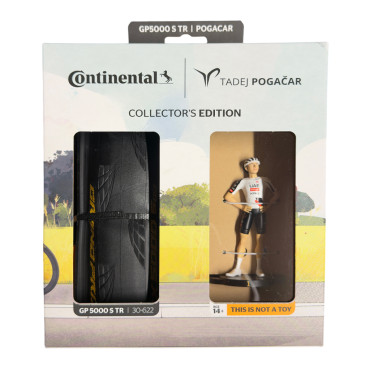
Model: GP 5000 S TR (S TR = Tubeless Ready)
This is the modern version, replacing the older TL version. It is designed to be lighter and is compatible with hookless rims, which broadens its compatibility.
Model: GP 5000 AS TR (AS TR = All Season)
This model is specifically designed to offer greater robustness and grip, particularly in bad weather.
Model: GP 5000 TT TR (TT TR = Time Trial / Time Trial)
This model is the fastest tyre in the range, optimised for power output and lightness.
| Main criterion | Recommended model | Mounting type | Strengths |
|---|---|---|---|
| Simplicity / Inner tubes | GP 5000 (Classic) | Tubetype | Best balance of performance and durability for inner tubes. |
| Speed / General use Tubeless | GP 5000 S TR | Tubeless Ready | Excellent comfort, fast, versatile, compatible with hookless rims. |
| Durability / Winter / Dirt roads | GP 5000 AS TR | Tubeless Ready | Reinforced sidewalls, improved cut resistance and longevity, excellent grip in wet conditions. |
| Competition / Top speed | GP 5000 TT TR | Tubeless Ready | The fastest in the range Continental, low rolling resistance. |
The choice of section (25mm, 28mm, 30mm, 32mm) is also crucial, as a wider tyre increases comfort and grip and can improve speed, even if the tyre is slightly heavier.
Continental ’s Grand Prix 5000 tyre is undoubtedly the epitome of a ‘versatile’ tyre. Its dynamic qualities – both in rolling performance and grip through bends and corners – border on excellence. Its good puncture resistance and enhanced comfort make it a reliable tyre that never lets you down.
Designed for performance, the Grand Prix 5000 is recommended for all experienced cyclists who refuse to compromise. With a wide range of sizes and cross-sections, available as genuine Tubeless, every cyclist is sure to find the tyre model that suits them.
Frequently asked questions
The Grand Prix 5000 range comprises five main variants, each designed for a specific use. The choice is made in two stages: first, the type of fitting (tubetype or tubeless); second, the specialisation (all-season, time trial, off-road).
The GP5000 Tubetype (classic) is the inner-tube version, with a 330 TPI casing. It is the go-to tyre for cyclists who do not wish to switch to tubeless; it remains one of the best on the market in terms of pure performance when fitted with a latex inner tube. The GP5000 S TR is the tubeless version of the range, with a 220 TPI casing (2 plies of 110): lighter and more flexible than the original TL, it is the ideal choice for cyclists wishing to ride tubeless for performance and puncture prevention. The GP5000 AS TR (All Seasons) is the all-season tubeless version, featuring a reinforced casing, improved grip in wet conditions and superior mileage, albeit at the cost of a higher weight. The GP5000 TT TR is designed for time trials and triathlons: minimal casing, feather-light, but fragile in everyday use. Finally, the GP5000 Transparent is a version with transparent sidewalls for aesthetic appeal.
Beyond the fitment, the two tyres have fundamentally different constructions. The S TR isn’t simply the GP5000 made tubeless-compatible; it’s a tyre that’s been completely redesigned from the inside out.
The casing of the GP5000 Tubetype consists of three plies of 110 TPI, totalling 330 TPI: a dense, rigid construction, optimised for use with a latex inner tube to ensure flexibility. The S TR uses two plies of 110 TPI (220 TPI in total) with an integrated, airtight liner running from bead to bead, which also protects the sidewalls. This design makes the S TR inherently more flexible, lighter and more comfortable than its Tubetype counterpart. In terms of performance, the tubeless version, with its liner, allows riding at lower pressures than a Tubetype (between 4 and 6 bar depending on the tyre size), which improves comfort and grip. Continental and independent tests confirm a ~5 per cent reduction in rolling resistance for the tubeless version compared to the Tubetype. The downside is that the S TR is slightly more vulnerable to clean cuts from sharp objects, as its carcass is less dense.
The optimum width depends on three factors: the internal width of your rim, your weight, and the type of road you usually ride on. By 2026, 28 mm had become the standard for the majority of road cyclists.
At 25 mm, the GP5000 offers the best balance of weight, aerodynamics and efficiency on narrow rims (internal width ≤ 17–19 mm). It is the choice of competitive cyclists or sprinters riding on aerodynamic, profiled rims. Please note: on rims with an internal width of 19 mm or more, the 25 mm width may no longer be the aerodynamically optimal option. The 28 mm width is now the performance standard on modern rims with an internal width of 19–21 mm; it offers significantly greater comfort than the 25 mm width for a weight and efficiency that are virtually equivalent, or even better depending on road conditions. With 30–32 mm tyres, we enter the all-road and long-distance cyclosportive territory: comfort on rough roads is remarkable, cornering grip is excellent, and several users confirm that the extra weight is imperceptible whilst riding. The 32 mm option is ideal for bikepacking, Paris–Roubaix- Challenge -style rides and rides on poorly maintained country roads.
Yes, the GP5000 S TR is hookless-compatible, but there are width and pressure restrictions that must be strictly adhered to, as specified by the rim manufacturers.
The S TR has been designed in accordance with ETRTO standards, allowing it to be fitted to hookless rims. However, some manufacturers of hookless rims impose specific limits: Giant, for example, only confirms compatibility of the GP5000 S TR 25 mm with its 42 mm SLR 1 and SLR 2 rims. For 28 mm and above, compatibility is generally assured on the vast majority of hookless rims on the market (Zipp, DT Swiss, etc.). The maximum pressure on a hookless rim is limited to 5 bar (72 psi), which is more than sufficient for tubeless tyres for cyclists weighing up to approximately 85 kg. Above this weight, or on very technical roads where you’re out of the saddle, this pressure limit may cause problems. The golden rule: always check your rim manufacturer’s compatibility chart before buying, and never exceed the maximum pressure specified on the hookless rim.
La pression optimale n'est pas universelle : elle dépend du poids total (cycliste + vélo), de la section du pneu, de la largeur de jante et du type de montage (tubetype ou tubeless). Rouler à la bonne pression est l'un des paramètres les plus impactants sur le rendement et le confort.
En tubeless S TR 28 mm, les repères courants sont : environ 4,2-4,5 bars à l'avant et 4,5-5 bars à l'arrière pour un cycliste de 65-70 kg, et 4,8-5,5 bars à l'arrière pour 80-90 kg. En Tubetype 25 mm avec chambre latex, les pressions sont plus élevées : 6,5 à 7,5 bars selon le gabarit, avec des pressions plus basses qui ne présentent pas de risque sur les jantes à crochet. La différence fondamentale : en tubeless, on peut baisser la pression de 0,5 à 1 bar par rapport au Tubetype sans risquer le pincement, ce qui améliore directement le confort et l'adhérence. Plusieurs calculateurs de pression en ligne (notamment Silca et SRAM) permettent d'obtenir une valeur personnalisée en renseignant poids, type de jante et section. Rouler systématiquement à la pression maximale recommandée est inutile et contre-productif sur macadam ordinaire.
The GP5000 Tubetype is one of the most durable tyres in its category for everyday use: users commonly report a lifespan of 5,000 to 7,000 km. The GP5000 S TR is slightly less durable due to its thinner casing.
On the Tubetype, the dense 330 TPI casing and the Vectran Breaker provide effective protection for the tread. The tyre wears down gradually without the pronounced square tread pattern seen on the older GP4000 models. A lifespan of 5,000–7,000 km is achieved with mixed training and road use; some demanding users replace them at around 4,000–4,500 km after noticing a loss of grip. On the GP5000 S TR, the 220 TPI casing is inherently more exposed: several users report a lifespan of 4,000–5,000 km under normal conditions, with slightly lower cut resistance than the older GP5000 TL. Continental has made the casing lighter to improve flexibility and performance; this is a deliberate trade-off. The GP5000 AS TR, with its reinforced casing and thicker tread, offers greater durability than the S TR, albeit at the cost of increased weight.
The GP5000 S TR is one of the easiest tubeless tyres on the market to fit. With the right method, a reservoir pump (or even a foot pump) is sufficient in most cases.
The six-step procedure. Apply the tubeless tape to the rim, covering all the spoke holes, wrapping it round at least one and a half times and paying particular attention to the joins. Fit the tubeless valve. Fit the tyre dry, without any sealant, by snapping both beads into the rim hooks by hand; a light coating of soapy water on the beads makes the process much easier. Connect a pump with a reservoir and inflate quickly: the GP5000 S TR usually seats itself at 4–5 bar without any major difficulty. Once both bead edges are properly centred in the rim beads, deflate the tyre, inject 25–30 ml of sealant via the valve, close the valve and reinflate to the desired pressure. Shake and rotate the wheel to distribute the sealant evenly across the entire inner surface. If the tyre does not seat properly with a standard pump, a temporary inner tube (inflate, deflate) can help position the beads before pressurising.
Both tyres are tubeless, feature the Black Chili compound and Vectran Breaker, but are designed for different priorities. The S TR is the performance tyre; the AS TR is the all-rounder/durability tyre.
The GP5000 S TR is the performance choice: maximum efficiency, lightweight (approx. 265 g in 28 mm), excellent grip on dry roads. Its main drawback is its relative fragility compared to previous seasons and its reduced performance on cold, wet roads, where the Black Chili compound is less effective. The GP5000 AS TR features a reinforced casing, a different tread pattern (Lazer, improved grip) and a compound optimised for low temperatures and wet conditions. It is noticeably heavier (~340 g in 28 mm), but field tests confirm that this extra weight is practically imperceptible whilst riding. For a cyclist covering 5,000+ km a year in all seasons in a damp region or in the mountains, the AS TR is the best annual investment. For a cyclist who stores their road bike away in winter and only uses performance tyres from March to October, the S TR is superior.
The GP5000 has consistently topped or been among the top three in rolling resistance benchmarks since its release in 2018. Its balance of performance, puncture resistance and durability remains hard to beat in its price range.
Independent measurements by Roland Resistance confirm that the GP5000 S TR 28 mm has a rolling resistance of approximately 9.7 W at 40 km/h and a total load of 120 kg, a level comparable to the Vittoria Corsa Pro TLR and slightly higher than the Schwalbe Pro One, which offers a longer lifespan but slightly less grip on wet roads. The Pirelli P Zero Race TLR offers easier fitting and slightly lower rolling resistance at the cost of a more fragile casing. The GP5000’s strength lies in its balance: it isn’t the best in every respect but has no deal-breaking flaws; it is manufactured in Germany (Korbach) to recognised quality standards, and its distribution network is the most extensive on the market. For a cyclist looking for a tyre they can buy anywhere in France and Europe as a spare, the GP5000 also has this practical advantage that not all its competitors offer.
The standard recommended amount is 25 to 30 ml per tyre for road use. Some users increase this to 40–60 ml on wider tyres (32 mm) or in all-road conditions. The sealant should be replaced every 4 to 6 months, depending on the climate.
The amount of sealant should be sufficient to cover the entire inner surface of the tyre as it rotates, but not so much as to make the wheel unnecessarily heavy. Most sealant manufacturers (Stans NoTubes, Silca, Orange Seal) recommend 25–30 ml per tyre for 28 mm road tyres. For 32 mm tyres, doubling the amount (50–60 ml) improves self-sealing effectiveness, according to user feedback. The puncture-proof fluid gradually dries out as it evaporates through the tyre carcass: after 4 to 6 months, the remaining amount may be insufficient to seal a puncture. Before long rides or cyclosportives, open the valve and shake the wheel to check that you can still hear liquid inside; if there’s no gurgling sound, you’ll need to top it up. High-performance sealants such as Stans’ Race or Silca Ultimate reduce the frequency of top-ups but cost more than standard ones.