Rolling resistance of bicycle tyres
The rolling resistance of road bike tyresis is a key factor in cycling performance. To minimise its impact, it is important to understand the various factors involved.
TheThe rolling resistance of road bike tyres is largely determined by their tendency to flatten under the weight of the bike and rider. This creates a larger tyre footprint on the ground and therefore greater resistance to pedalling.
Rolling resistance of road bike tyres: inflation!
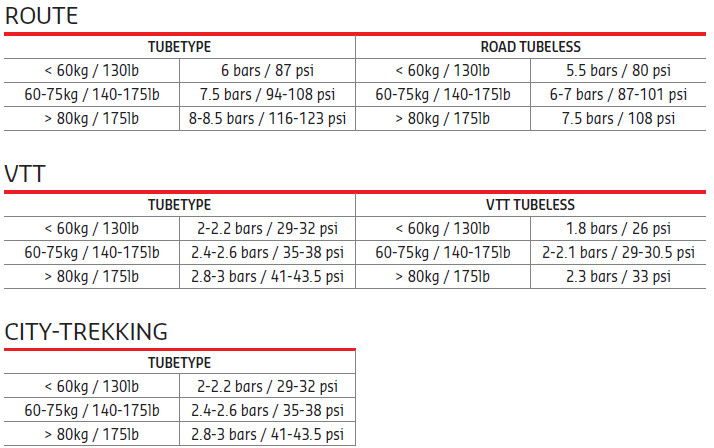
Tyre pressures for road bikes and mountain bikes according to Hutchinson.
Obviously, proper inflation will minimise this footprint. As is to be expected, the minimum and maximum inflation tolerances must be respected, but above all, the 10% rule must be observed. On road bikes, it is generally accepted that tyre pressure should be equivalent to 10% of the rider's weight. This is only a guideline and should be adjusted according to use.
Indeed, while a tyre inflated to 8 bar will certainly improve performance, it will not be very comfortable! Furthermore, an overinflated tyre will perform poorly on poor road surfaces, instead ofabsorbing shocks, it will bounce on rough surfaces, thereby reducing pedalling power.
Rolling resistance of road bike tyres: the tyre section
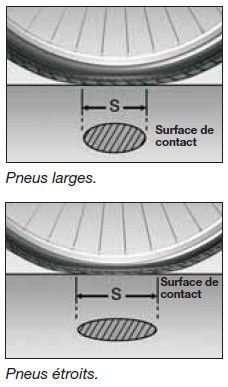
The rolling resistance of 23 or 25 mm road bike tyres according to Schwalbe.
The increasingly widespread idea that 25 mm tyres perform better than 23 mm tyres is true to a certain extent. In fact, at the same pressure and with the same construction, 23 mm and 25 mm tyres have the same footprint when the rider is not on the bike. However, once the rider is on the bike, the tyres flatten. The 25 mm tyre will flatten in width, while the 23 mm tyre will flatten in length, thus generating a larger footprint and therefore greater rolling resistance. In addition, 25 mm tyres offer greater comfort, as they require lower inflation pressure, thus preserving the cyclist's energy throughout the ride. However, the superiority of 25 mm tyres over 23 mm tyres should be put into perspective. Air resistance remains the primary obstacle to a cyclist's forward momentum. at speeds above 20 km/h, air resistance is a greater brake than rolling resistance. This is why professional cyclists, for whom comfort is not a priority, continue to favour 23 mm tyres, which are more responsive, lighter and offer better acceleration. [Editor's note: thank you to Guillaume for his vigilance. He points out in a comment that "if you check the tyres before setting off, you can avoid any unpleasant surprises". Guillaume for his vigilance. He points out in a comment that "if you look at the bikes before the start of a professional race, you'll see that 80% of the tubular tyres are 25 mm. FDJ, Trek, Europcar... They all choose this section for performance reasons (better than 23 mm), but also for aerodynamics, carbon rims are becoming wider, and 25 mm tubular tyres prevent air from being sheared off behind the rim.
Rolling resistance of road bike tyres: the carcass
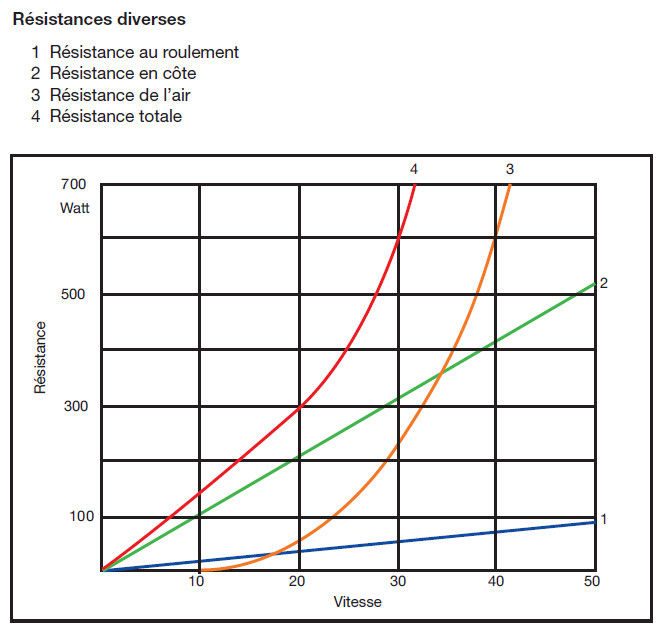
The various factors affecting the rolling resistance of a bicycle.
The density of the bicycle tyre casing also plays a role in its rolling resistance. As a reminder, this is expressed in TPI (Thread Per Inch, where 1 inch is equivalent to 2.54 cm). This value is determined by the number of threads that make up the carcass over a given surface area. The higher the number of threads over the same surface area, the finer they will be. In this case, even if there are more threads, the overall weight of the tyre is reduced because less rubber is used to fill the spaces between each thread. Rolling resistance is therefore proportionally reduced. Cotton and silk casings offer the best performance and comfort thanks to their flexibility (they bounce less on rough roads than tyres with nylon casings). It should be noted that some manufacturers, such as Michelin and Hutchinson, advertise a TPI per layer of thread. However, a tyre carcass is made up of three layers of thread in some places, and manufacturers such as Vittoria highlight the cumulative TPI of these three layers!
Rolling resistance of road bike tyres: the tread

A tyre subjected to torture in the Mavic workshops.
A smooth tyre with soft rubber will offer less rolling resistance than a tyre with grooves and hard rubber. First of all, in order to grip the road, the rubber must deform to fit its contours. This means that a soft rubber compound requires less energy when pedalling because it deforms more easily (however, it will have a shorter lifespan because it will wear out more quickly). Similarly, a smooth tyre offers better contact with the road, further facilitating power transmission.