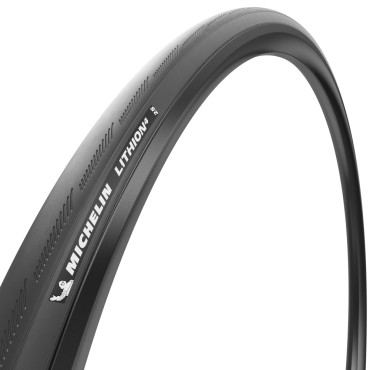
Michelin tyres are known to sometimes have an actual width that is smaller than the advertised size. Customers report that the 25 mm Lithion 4 actually measures 23 mm when inflated to 7 bar, and that the 32 mm model measures 28 mm with a calliper once fitted. Conversely, older generations such as the Lithion 3 often measured wider than stated. This phenomenon also depends on the internal width of the rim. If you are looking for a specific tyre width, particularly to optimise comfort or puncture resistance, it is advisable to choose a wider size than the one you require. Matériel Vélo’s customer service team can advise you based on the model.
The Power Endurance Michelin has an excellent lifespan: customers report 7,000 to 8,000 km on the front tyre and 7,000 km on the rear tyre under normal conditions. The Pro4 Endurance offers similar durability, with customer reviews reporting over 3,000 km on the rear tyre alone for a rider weighing 60 kg. This performance is down to the triple-layer X-Miles rubber compound and the Protek+ aramid reinforcement. On the other hand, these tyres are neither the lightest nor the smoothest-rolling: they sacrifice a little pure performance in favour of durability. For intensive cyclosportives or cycle touring, this compromise is often ideal.
Several customers report that the Power Road TLR is one of the easiest tubeless tyres to fit, particularly on Ksyrium rims Mavic. Customer reviews confirm that it can be fitted by hand without tools, even on rims known to be difficult. However, one isolated review mentions a problem with porosity after one year and approximately 1,000 km on one of the two tyres. Michelin replied that sealant issues with TLR tyres can be caused by poor storage or a lack of maintenance. To maximise the tyre’s lifespan, check the pressure regularly and add sealant every 4 to 6 months.
All three belong to Michelin ’s performance range but are aimed at different levels. The Power Cup (formerly Power Road) is the all-rounder, featuring X-Race, which offers an excellent balance of efficiency, grip and durability. The Power Race moves up the range with a lighter casing and enhanced performance for competition. The Power Competition is the top-of-the-range racing tyre, featuring the lightest rubber compound and the best rolling efficiency, but with a shorter lifespan. For most recreational cyclists, the Power Cup offers the best all-round balance. Customers who have used the Power Cup report good handling in both dry and wet conditions.
Yes, the Lithion 4 tyres are designed for training, with a claimed lifespan of over 7,000 km for the rear tyre. The Magi-X Master Benefit compound, derived from MotoGP technology, offers good grip in both dry and wet conditions. Customers have reported using them successfully in cyclosportives on country roads. One notable drawback: some reviews mention instability at low pressure and a vague feeling at the front, particularly when going downhill. The actual tyre width is sometimes narrower than stated. For use exclusively for training on good-quality tarmac, they offer excellent value for money within their price range.
The Power All Season V2 is specially designed for tough conditions: its triple-layer 60 TPI casing with Protek aramid reinforcement ensures excellent puncture resistance on wet or debris-strewn roads. Customers have fitted the 700x28c version on roads covered in flint without a single puncture. Its all-season compound offers excellent grip in both dry and wet conditions, as confirmed by several reviews. It is slightly heavier than the pure-performance versions but offers far greater durability. For cyclists who ride all year round or live in a rainy region, this is often the best choice.
Michelin It offers TLR (Tubeless Ready) versions such as the Power Road TLR, but these are designed for Tubeless Ready or UST rims. On a standard tubetype aluminium rim, tubeless fitting is not recommended as an airtight seal cannot be guaranteed. On a tubetype carbon rim, fitting is technically possible but more tricky, according to Matériel Vélo’s customer service. The standard tubetype version (with an inner tube) remains available for all models and can be fitted without any issues to any 700c-compatible rim. If you are unsure about rim-tyre compatibility, please seek advice from customer services.
Michelin We recommend a pressure range suited to your weight and the tyre width. For a 70 kg cyclist riding a 700x25 tyre, the pressure will generally be between 7 and 8 bar (100 to 115 psi). With 700x28 tyres, the pressure can be reduced to 6–7 bar to improve comfort without compromising performance. The current trend is to run lower pressures with wider tyres: on a 700x28, reducing the pressure to 6.5 bar on a decent road significantly improves comfort without increasing the risk of a puncture. TLR tyres generally allow for slightly lower pressures than their tubular equivalents.
Yes, the Protek Cross FR Michelin is an all-terrain tyre designed for mixed-use: cycle commuting, gravel riding, hybrid bikes and e-bikes. Customers have reported using the 700x35c version for their commutes, with unanimous praise for its durability and its reflective strip, which is visible at night. Its 3D tread pattern ensures good grip on roads and non-technical trails. It is not designed for technical trails or steep, muddy slopes. For versatile gravel riding that alternates between roads and trails without major rough patches, it offers an excellent balance. Available with rigid beads for easy fitting and an affordable price.
Yes, the Michelin Dynamic Sport is used by several customers on indoor trainers, particularly on roller trainers. Its 30 TPI casing and slick tread pattern make it a low-profile tyre that leaves almost no rubber behind after a few sessions of use, according to customer feedback. Its very affordable price (from 13 euros) makes it a cost-effective option for dedicating a rear tyre solely to use on a home trainer. For a home trainer with tyre-based resistance, specific models such as the Vittoria Zaffiro Home Trainer are more suitable, as their rubber compound is formulated to withstand the heat generated by the roller.