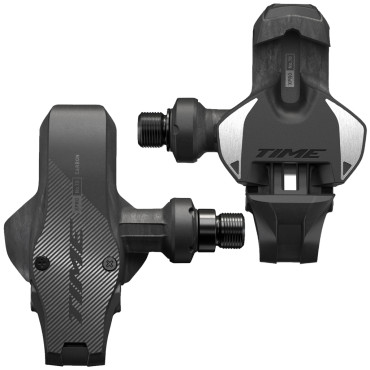
The XPresso are Time ’s versatile road pedals, whilst the XPRO are the top-of-the-range models featuring a wider carbon body. The XPresso (4 and 6) use the iClic system, have a contact area of 700 mm² and a steel axle. The XPRO (10, 12, 12 SL) models increase the contact area to 725 mm², feature a stiffer carbon body and offer three clip tension settings. The XPRO 12 SL is the ultra-light version with a hollow titanium axle and ceramic bearings (87 g per pedal). A key new feature on the XPRO range: three axle lengths are available (51, 53, 57 mm) to adapt the Q-factor to the cyclist’s build.
iClic is Time ’s pre-opening system: the pedal cleat is open by default and closes automatically when the cleat presses against it. Unlike the Look or SPD systems, where you have to push the cleat against a closed spring, with Time iClic the clip opens first, then locks the cleat in place. Advantage: very easy to clip in, even whilst pedalling or with dirty shoes. The angular play is ±5° and the lateral play is ±2.5 mm. It is possible to lock the lateral play by reversing the cleats.
No: Time pedals use a proprietary cleat system that is incompatible with Look Keo cleats. The mounting holes on the shoes are the same 3-screw standard, but the cleats have different geometries. For road cycling, Time uses iClic cleats (supplied with the pedals). For gravel and road cycling, the Time Cyclo pedals use ATAC cleats (2-screw MTB standard), which means you can use a single pair of shoes for multiple disciplines.
Yes, Time is a French brand founded in 1987 in Voreppe (Isère), a pioneer in clipless pedals. It was Time that invented the ATAC clipless pedal for mountain bikes in 1994. Since 2019, Time has been part of the Rossignol Group, a global skiing giant. This takeover brought industrial expertise in composites and bindings, addressing long-standing criticisms regarding the reliability of road bike pedals. Time also manufactures high-end carbon frames (Alpe d’Huez, Skylon).
Yes, ATAC pedals are very popular for gravel riding thanks to their self-cleaning system. The movable front arch expels mud and debris every time you clip in, keeping the pedal clean even on wet terrain. The ATAC XC 6 and XC 8 are the most commonly used models for gravel riding. They use the widely available Shimano-compatible 2-screw SPD cleats. The only drawback on long rides is that they are single-sided, which requires a little more care when clipping in quickly.
Yes, the XPRO range marks a turning point in the reliability of Time road bike pedals. The previous Time pedals (pre-XPRO) had a reputation for being fragile: play in the axle, and jaws that wore out quickly. Following the takeover by Rossignol, the new XPRO pedals have benefited from expertise in ski bindings: a reinforced body, a new axle design and more thoroughly tested composite materials. Long-term tests on the XPRO 10 (over 10,000 km) confirm a significant improvement, although the jaws remain an area to monitor after several thousand kilometres.
Yes: the stack height of the Time pedals is 13.5 mm, one of the lowest on the market. This reduced height allows for a more natural pedalling motion, bringing the foot closer to the bottom bracket. By way of comparison, the Keo Blade pedals from Look have a stack height of 14.8 mm. This difference of 1.3 mm is noticeable on long rides for cyclists with sensitive joints. It’s a point often cited by loyal Time customers who return to the brand after trying other systems.
On XPRO models, the tension can be adjusted to 3 positions via the carbon lever, without tools, simply by flipping it. Position 1 (easy): for beginners or cyclists wanting to be able to slip out easily. Position 2 (standard): the recommended medium tension for most cyclists. Position 3 (firm): for cyclists requiring a rigid hold, suitable for intense sprints. On XPresso pedals, the tension is adjustable via a small eccentric screw on the side of the pedal.
Yes, Time remains active in the manufacture of high-end carbon frames, although pedals remain its core business. The Time range of frames includes, in particular, the Alpe d’Huez (designed for mountain riding) and the Skylon (all-rounder). Time ’s frames are manufactured in France using high-modulus carbon fibre. They are renowned for their comfort and vibration damping, thanks to Life Carbon technology. Whilst the range remains relatively unknown compared to the major brands, it retains a loyal following amongst cycling enthusiasts.
Time ’s iClic cleats have a decent lifespan thanks to the overmoulding technology that protects the contact areas. The older Time cleats had a reputation for premature wear. The new iClic cleats (current version) benefit from a new injection moulding system at the core of the mould, which improves their strength and durability. In practice, you can expect to ride 5,000–8,000 km before noticing any significant play. The iClic Float cleats (with angular freedom) and the iClic Fix cleats (without angular freedom) are available separately.