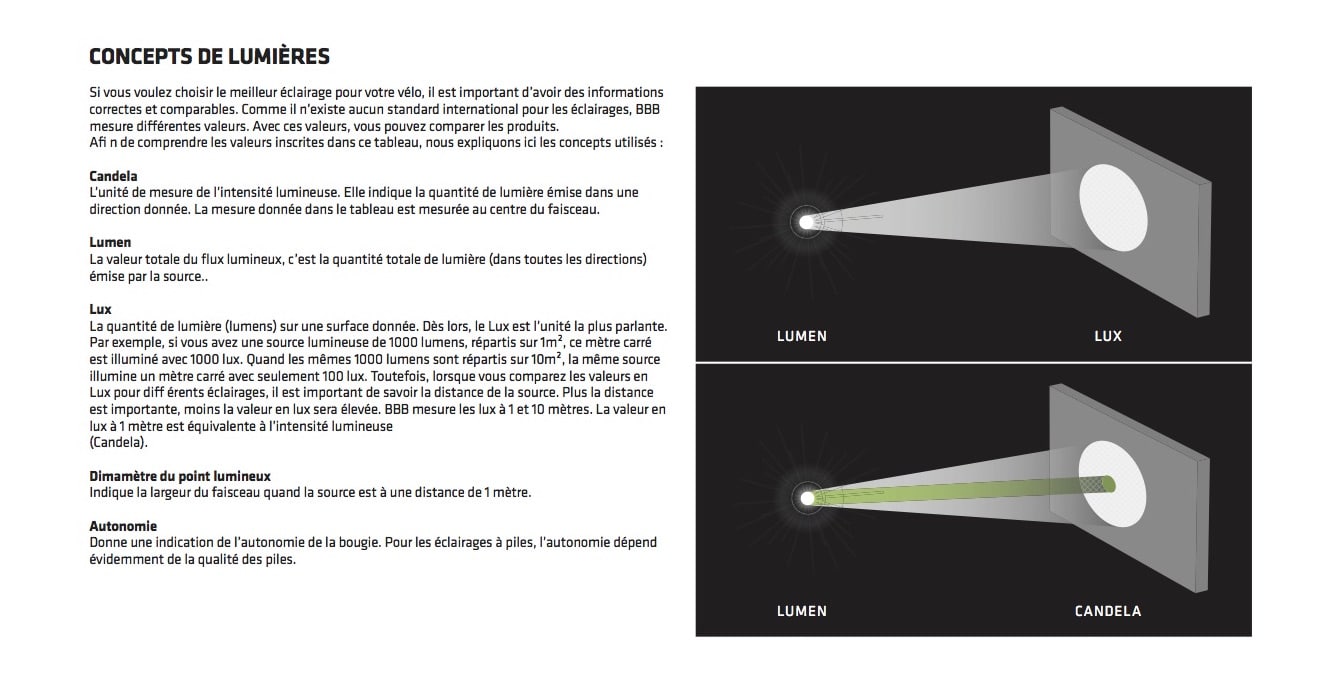
Bicycle and mountain bike lights are essential for riding safely in winter. It's important to see, but above all to be seen! However, the requirements vary between a bike designed for urban use and a bike designed for racing.How do you choose the most suitable lighting for your needs?Lux, Lumen: what are the differences?Some manufacturers advertise the power of their lighting in lumens, others in lux, although the trend today is towards standardisation in lumens. There is a significant difference between these two terms, and it is best to be informed to avoid disappointment. The strong>Lumen is the unit of measurement of the light emitted by a light source, whether you are locatedclose to or far away from the light source. This value therefore remains unchanged regardless of your position in relation to the light source: it is the amount of light that the lighting can produce. Lux indicates the amount of light at a given point on an illuminated surface (the road, a wall). It therefore indicates the light intensity at a specific point distant from the light source. It is the lighting lens that will make the difference in the calculation of Lux. The more this lens focuses the light beam, the higher the Lux value will be at a given point. A good lens will be able to illuminate nearby, distant and lateral areas evenly.
|>
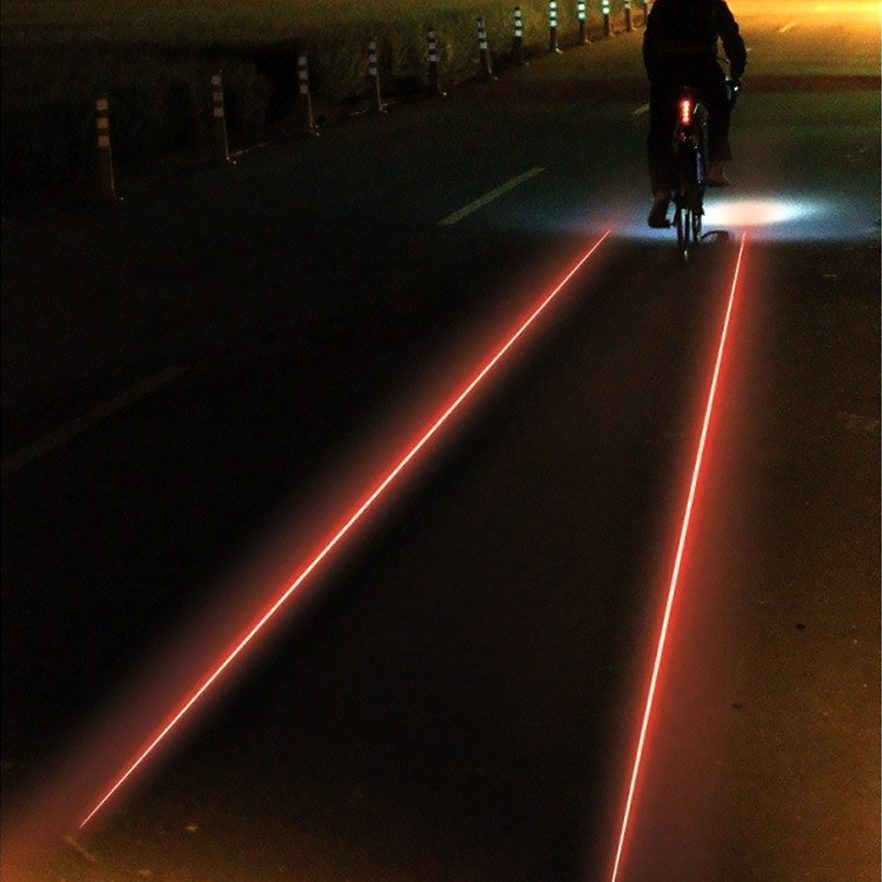
LEDs have definitively replaced bulbs in bicycle lighting! Their low weight, virtually infinite lifespan and compact size are undeniable advantages. LEDs are therefore used in almost all current bicycle lighting, although a few halogen lamps still remainfor city bikes. Next come lighting power and beam shape. Lower power will allow you to be seen, but you will need to opt for a more powerful model if you want to see in front of you when the light is low. The shape of the beam will allow you to see to the side if you want to see in front of you when the light is low.egrave;le if you want to see in front of you when the light is low. The shape of the beam will allow you to see in a specific area or benefit from a wide beam. Consider checking this parameter according to your needs. Also consider the different display modes, which will allow the bike light to adapt to all conditions, but also to the different types of road.display modes that will allow the bike light to adapt to all conditions, but also to extend its battery life. There is fixed lighting with variable intensities, but also flashing (less energy-intensive) or even Blast mode for use in daylight. Some modelseven project lasers onto the ground to indicate safety distances, while others even have a dash cam. dash cam".
|>
What criteria should you use to choose?
LEDs have definitively replaced bulbs in bicycle lighting! Their low weight, virtually infinite lifespan and compact size are undeniable advantages. LEDs are therefore used in almost all current bicycle lighting, although a few halogen lamps still remainfor city bikes. Next come lighting power and beam shape. Lower power will allow you to be seen, but you will need to opt for a more powerful model if you want to see in front of you when the light is low. The shape of the beam will allow you to see to the side if you want to see in front of you when the light is low.egrave;le if you want to see in front of you when the light is low. The shape of the beam will allow you to see in a specific area or benefit from a wide beam. Consider checking this parameter according to your needs. Also consider the different display modes, which will allow the bike light to adapt to all conditions, but also to the different types of road.display modes that will allow the bike light to adapt to all conditions, but also to extend its battery life. There is fixed lighting with variable intensities, but also flashing (less energy-intensive) or even Blast mode for use in daylight. Some modelseven project lasers onto the ground to indicate safety distances, while others even have a dash cam. dash cam". The Lezyne Laser Drive rear lightcalculates the safe distance using lasers projected onto the ground. there are models that run on batteries, rechargeable batteries via USB, or removable batteries. It is important to determine how long you need the light to be on and, therefore, how much battery life you need.lt;br />
One last question related to the previous one: What type of mounting should I choose for my lighting: removable or fixed? Many models are now removable, particularly those with a short battery life, to make frequent recharging easier.|>
Urban bike lights
In towns and cities, street lighting is generally sufficient to see ahead. However, to be seen by other road users, it is mandatory to have a lighting device. A power of 20 to 30 lumens for front lighting will ensure that you are seen effectively. If streetlights are few and far between, a power of 100 lumens will be necessary to light up the road. For the rear, 15 lumens will be enough to be seen. With numerous intersections, a model with side lighting will be welcome. Compact, easy-to-recharge lights are therefore ideal for city use and very practical for everyday use. If you usually park your bike in a public place, it would be safer to choose a removable model that you can simplyamp;agrave; ranger dans votre poche quand laisserez votre vélo.
Road bike lights
On the road, front lights must offer a minimum power of 300 lumens. Don'tDo not hesitate to choose a model with a wide beam so that you can also see to the sides. There are models with more than 1000 lumens. If you opt for this type of lighting, we recommend that you install them correctly and point them downwards so as not to dazzle oncoming vehicles.If you plan on going on long night-time trips, a model with a removable battery will allow you to take a second one with you to increase the battery life.increase the range. At the rear, 100 lumens of power will allow you tobe seen from several hundred metres away, which is particularly useful on roads with a speed limit of 80 km/h: car drivers and motorcyclists will have time toanticipate and keep their distance to overtake safely.
Mountain bike lights
For mountain biking, especially on technical terrain, you need to be able to see obstacles clearly and as early as possible. In this case, powerful lighting with a wide beam is best, so you can see a large area and change direction if necessary. We recommend choosing a power of 800 to 1000 lumens. It is also possible to combine a light on the bike with a "mobile" light that follows your gaze on your helmet, always with the aim of anticipating the next difficulties as much as possible."mobile" light that follows your gaze, on your helmet, always with the aim of anticipating any difficulties ahead. There are bike lights with batteries on the frame. Suitable for mountain biking, they have the advantage of being very robust and durable. Their battery will need to be recharged from the mains. For the rear, if you are riding on paths closed to motor traffic, a small 20-30 lumen light will be more than enough.If you need to use a public road to finish your ride, we recommend opting for a more powerful light (see previous paragraph).
Be careful not to leave the battery of your bike lights completely empty for long periods of time, as this could damage it, reducing its autonomy or making it impossible to recharge. Most cyclists only use their bike lights in winter, so it is advisable to charge the battery regularly, even when not in use.When not in use, it is also advisable to charge the battery regularly. Similarly, to optimise battery life, it is not recommended to wait until the battery is completely empty before charging it.it is completely empty before charging it.
One last question related to the previous one: What type of mounting should I choose for my lighting: removable or fixed? Many models are now removable, particularly those with a short battery life, to make frequent recharging easier.|>
What do I need ?
Urban bike lightsIn towns and cities, street lighting is generally sufficient to see ahead. However, to be seen by other road users, it is mandatory to have a lighting device. A power of 20 to 30 lumens for front lighting will ensure that you are seen effectively. If streetlights are few and far between, a power of 100 lumens will be necessary to light up the road. For the rear, 15 lumens will be enough to be seen. With numerous intersections, a model with side lighting will be welcome. Compact, easy-to-recharge lights are therefore ideal for city use and very practical for everyday use. If you usually park your bike in a public place, it would be safer to choose a removable model that you can simplyamp;agrave; ranger dans votre poche quand laisserez votre vélo.
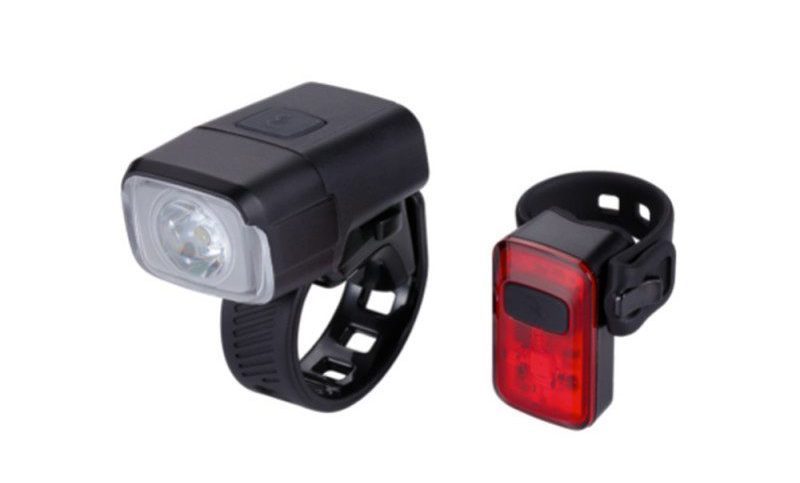
The BBB Nanostrike 400 duo, excellent value for money for urban use!
Road bike lights
On the road, front lights must offer a minimum power of 300 lumens. Don'tDo not hesitate to choose a model with a wide beam so that you can also see to the sides. There are models with more than 1000 lumens. If you opt for this type of lighting, we recommend that you install them correctly and point them downwards so as not to dazzle oncoming vehicles.If you plan on going on long night-time trips, a model with a removable battery will allow you to take a second one with you to increase the battery life.increase the range. At the rear, 100 lumens of power will allow you tobe seen from several hundred metres away, which is particularly useful on roads with a speed limit of 80 km/h: car drivers and motorcyclists will have time toanticipate and keep their distance to overtake safely.
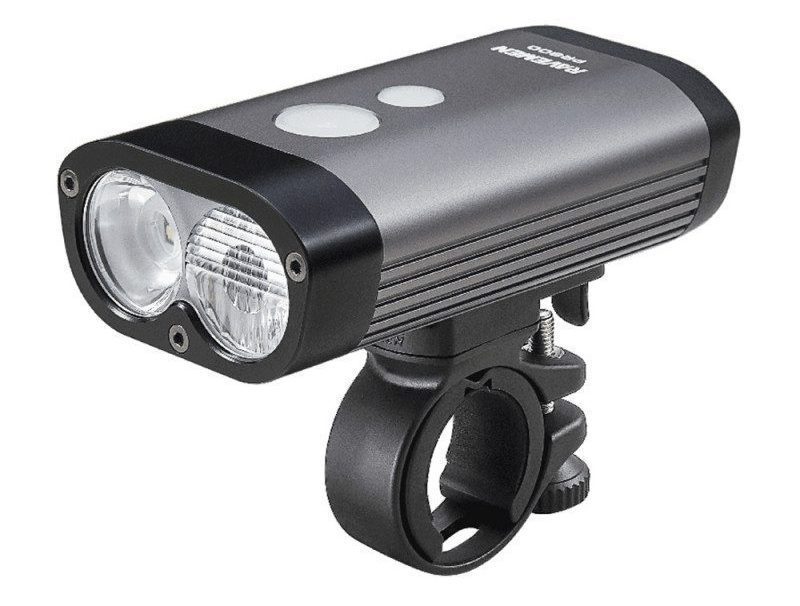
The Ravemen PR800, powerful lighting and external battery for your smartphone or GPS device
Mountain bike lights
For mountain biking, especially on technical terrain, you need to be able to see obstacles clearly and as early as possible. In this case, powerful lighting with a wide beam is best, so you can see a large area and change direction if necessary. We recommend choosing a power of 800 to 1000 lumens. It is also possible to combine a light on the bike with a "mobile" light that follows your gaze on your helmet, always with the aim of anticipating the next difficulties as much as possible."mobile" light that follows your gaze, on your helmet, always with the aim of anticipating any difficulties ahead. There are bike lights with batteries on the frame. Suitable for mountain biking, they have the advantage of being very robust and durable. Their battery will need to be recharged from the mains. For the rear, if you are riding on paths closed to motor traffic, a small 20-30 lumen light will be more than enough.If you need to use a public road to finish your ride, we recommend opting for a more powerful light (see previous paragraph).
Battery maintenance
Be careful not to leave the battery of your bike lights completely empty for long periods of time, as this could damage it, reducing its autonomy or making it impossible to recharge. Most cyclists only use their bike lights in winter, so it is advisable to charge the battery regularly, even when not in use.When not in use, it is also advisable to charge the battery regularly. Similarly, to optimise battery life, it is not recommended to wait until the battery is completely empty before charging it.it is completely empty before charging it.