
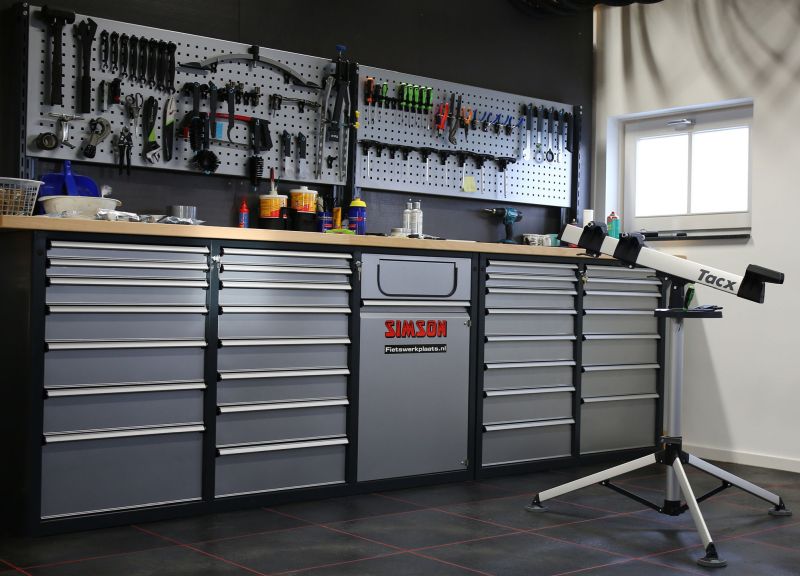
The bicycle and mountain bike toolkit includes a wide range of solutions tailored to every need. While some tools are specific to precise tasks, others are essential for even the smallest jobs. What tools do you need to build the ideal bicycle toolbox? There is no single, definitive answer to this question. Several variable criteria must be taken into account. These include the user's level of motivation to get involved in mechanics, as well as the different standards of bicycle components.
THE ultimate bike toolbox!The Park Tool MK234 Master Tool Kit includes 234 items. The Holy Grail for the most skilled mechanics.|>
However, it is possible toalready put forward a basic principle that is particularly suited to beginners. It is not necessarily useful to buy a complete bicycle tool kit. At a high price, it will certainly be satisfying, but it will undoubtedly include tools that you will never use. It is better toEquip yourself as and when you need to carry out work on your bike, from adjusting the saddle height to changing the fork. This is because the different standards introduced by manufacturers may require very specific tools, as ispedal box. There is therefore no need to buy a toolbox that includes a key forexternal bearing pedal crankset when you have a bike with a BB30 pedal crankset.
When it comes to budget, once again, quality should be prioritised over quantity. It is better to invest in high-end basic tools. As they are often used, their durability is essential. There is nothing more frustrating than a tool that breaks when you need it most.used often, so durability is essential. Nothing is more frustrating than "stripping"round off a hex screw head with a metal Allen key that is too soft: you will have to replace the screw and the key! Worse still, you risk irreparably damaging the bike's components. There are many brands of bike tools whose quality is well established: Park Tool, Var, Tacx, BBB, Lezyne, etc.
Basic bicycle and mountain bike tools
Although there are not many essential bicycle and mountain bike tools, they will enable you to carry out most operations on your bike. These tools foris not necessarily specific to cycling: most of it can be found in DIY stores.
Park Tool Home Mechanic Starter Kit bicycle toolbox. Everything you need to get started with bike mechanics: hex keys, screwdrivers, chain tool, etc.... Most of these tools can be found in DIY stores.
A Phillips screwdriver is essential for adjusting derailleurs and caliper brakes. But the most commonly used tool on a bike is definitely the Allen key, or hex key, hex wrench, or BTR key.on a bike is undoubtedly the Allen key, or hex key, or BTR key. The most commonly used sizes for bikes are 4.5 and 6 mm. You will need two sets of keys, if possible one short and one long. Short keys are suitable for all uses, but long keys offer greater force on seized parts. They also allow you to reach less accessible areas.also reach less accessible areas. Torx keys (or star keys) are not the most commonly used keys. Torx screws are rarely found on bikes, but they are very common for brake disc fixings.

A bicycle cable and sheath cutter will allow you to cut both cables and sheaths without crushing them. Highly recommended.|>
Still in the standard tools category, a ratchet wrench can be very useful as it can be fitted with sockets of all sizes, as well as special tools for cutting and stripping cables.useful as it can be fitted with sockets of all sizes, as well as highly specialised tools such as a cassette remover or a bottom bracket remover.A torque wrench is not essential for everyday use. However, it can prove useful for tightening bolts on a carbon frame, which is a sensitive material.very useful for tightening on a carbon frame, a material that is sensitive to crushing.
For their part, small pliers are very useful when changing cables, for example. A high-quality multi-grip pliers with no significant play in the adjustment system is suitable for many uses, from assembling parts tostraightening derailleur hangers (be careful, this is a dangerous operation if you don't know what you're doing!. A pair of standard cutting pliers is ideal for cutting cables.
Specific tools for bicycles and mountain bikesdiv align="center">
Derivative chain (here a Var model).
However, you will need to use special pliers to cut the cable sheaths. These have a rounded tip so as not to crush the round, hollow sheath. This brings us to the range of tools specific to bicycles, while also touching on the subject of tools that are useful for all types of work.crush the round, hollow sheath. This brings us to the range of tools specific to bicycles, which are still relatively simple to use. For example, a chain tool is very useful when assembling or maintaining the bicycle chain. You must ensure that it is compatible with the chain: there are 9, 10 and 11-speed chain tools available.|>

Chain whip for cassette removal.
The cassette remover and chain whip chain are two complementary and essential pieces of bicycle tooling for removing the cassette. The cassette remover is used to "unscrew" the cassette from the freewheel body, while the chain whip preventsthe cassette from turning.
A spoke wrench is required for mounting a wheel, replacing a broken spoke or removing a wheel.wheel truing. Please note that you will need to refer to the size of the spoke nut to ensure you have the correct size wrench. You can use a universal spoke wrench that includes several sizes. On the bottom bracket side, a chainring wrench will allow you to hold the chainring nuts in place during assembly and disassembly. As for the pedals, they may require specific pedal wrenches. These are very flat and made of steel.These are very flat and made of pressed sheet metal so that they can slide into the narrow gap between the crank and the pedal body.narrow gap between the crank and the pedal body. However, depending on the pedal model, a simple flat wrench may suffice.
Specialised bicycle and mountain bike tools</h3> 
Pressfit 30 bottom bracket cup extractor.
When it comes to transmission, bicycle mechanics require highly specialised tools. These are few in number and the average cyclist will rarely have occasion to use them, often preferring to entrust the work to a professional.will rarely have the opportunity to use them, often preferring to entrust the work to a mechanic. In addition, it is necessary to ensure that these tools are compatiblecompatibility of these tools with the bike's components. This is particularly true for the components that make up the crankset. For cranks, awill be required, but also a crank extractor tool to remove it from the axle.
The bottom bracketThe bottom bracket requires very specific bicycle tools depending on the technology used. The tools required are completely different depending on whether you are working witha BB30 or threaded bottom bracket with external bearings with 8, 12 or 20 splines...|> 
This Park Tool bottom bracket press is also suitable for installing headset bearings.br /> Although some tools are compatible with several models, in most cases you will need to use very specific equipment due to the significant differences in design between the various technologies. Finally, to change the headset bearings, you will need an extractor to remove the cups from the headset and a cup press to install them.
Other bicycle and mountain bike tools, workshop equipment and consumables Some tools, whether specialised or not, will prove useful in specific cases but are not essential. If thespecialised or not, may prove useful in specific cases but are not essential. If you do not intend to carry out certain specific operations, it is perfectly possible to do without them. This is the case with circlip pliers, which are essential for assembling BB30 bottom brackets and maintaining mountain bike forks.

Bicycle cable pull clip: a handy third hand for securing cables. Similarly, a cable puller will be very useful for installing a cable, acting as a third hand to hold the cableat the correct tension during tightening. Don't forget a metal ruler and a sliding foot. Two very practical accessories for ensuring the diameter and length of bicycle parts. For disc brakes, a brake fluid bleed kit will be necessaryFor disc brakes, a brake fluid bleed kit is necessary for annual servicing, as is a high-pressure pump for MTB forks with air adjustment. A tool for measuring chain wear is also useful.At home, it is entirely possible to set up a professional workshop! The first step is to get a workshop stand. If this is not possible, a bike stand with bases will allow you to keep the bike upright.step is definitely to get a workshop stand. If you don't have one, a bike stand with bases will keep the bike balanced. With the rear wheel suspended, you canmake adjustments to the derailleur, for example. For everything else, there are many devices available for carrying outprofessional repairs: derailleur hanger alignment tools, wheel aligners, tools for checking the alignment of the frame or frame dropouts, etc.
Bicycle workshop tools
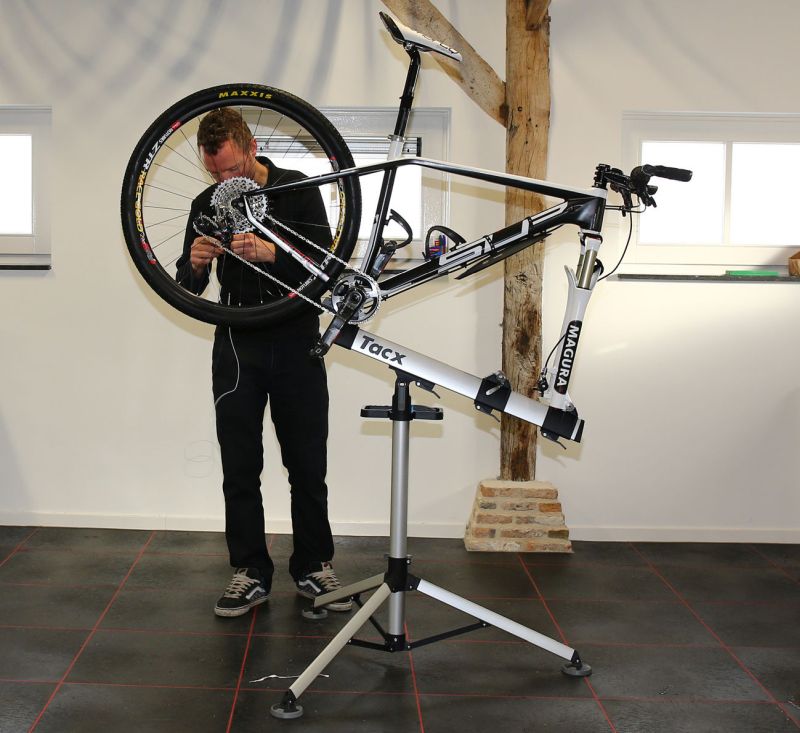
The workshop stand (here a Tacx T3350 Spider team) provides considerable working comfort.
As for bike consumables, always keep a degreaser at home for maintenance of the chainand cassette. Obviously, the chain and cassette should be oiled after cleaning and at regular intervals.As for grease, it should be reserved for bearings, such as those in the pedal housing.br /> Cable and hose end caps take up little space in a workshop and ensure a clean installation. A pr&Tubeless tyre repair kits can be stored on a shelf for bikes equipped with this type of tyre.
On-board bicycle and mountain bike tools

Multifunctional bike tool: essential for any ride.
Don't go cycling without a few basic tools! To deal with punctures, it's best to use a tube with patches. it is easier to change an inner tube than to remove it, locate the leak, repair it and then re-inflate the tyre. To do this, you will need two or three tyre levers. Also keep a multi-purpose tool with Allen keys and basic screwdrivers, a chain tool and even tyre levers in your pannier or backpack.You can also carry two cables, one for the brakes and the other for the derailleur.
Putting together a bicycle tool kit takes a little time, studying the equipment you will need to work on and a little common sense.and a little common sense. Choose high-quality equipment and don't hesitate to spend a little extra to avoid damaging your bike's components. There is no point in rushing out and buying equipment that you will not use! The cyclist's motivation to get their hands dirty will determine how much equipment is needed.
Pressfit 30 bottom bracket cup extractor.
This Park Tool bottom bracket press is also suitable for installing headset bearings.br /> Although some tools are compatible with several models, in most cases you will need to use very specific equipment due to the significant differences in design between the various technologies. Finally, to change the headset bearings, you will need an extractor to remove the cups from the headset and a cup press to install them.
Other bicycle and mountain bike tools, workshop equipment and consumables Some tools, whether specialised or not, will prove useful in specific cases but are not essential. If thespecialised or not, may prove useful in specific cases but are not essential. If you do not intend to carry out certain specific operations, it is perfectly possible to do without them. This is the case with circlip pliers, which are essential for assembling BB30 bottom brackets and maintaining mountain bike forks.
Bicycle cable pull clip: a handy third hand for securing cables. Similarly, a cable puller will be very useful for installing a cable, acting as a third hand to hold the cableat the correct tension during tightening. Don't forget a metal ruler and a sliding foot. Two very practical accessories for ensuring the diameter and length of bicycle parts. For disc brakes, a brake fluid bleed kit will be necessaryFor disc brakes, a brake fluid bleed kit is necessary for annual servicing, as is a high-pressure pump for MTB forks with air adjustment. A tool for measuring chain wear is also useful.At home, it is entirely possible to set up a professional workshop! The first step is to get a workshop stand. If this is not possible, a bike stand with bases will allow you to keep the bike upright.step is definitely to get a workshop stand. If you don't have one, a bike stand with bases will keep the bike balanced. With the rear wheel suspended, you canmake adjustments to the derailleur, for example. For everything else, there are many devices available for carrying outprofessional repairs: derailleur hanger alignment tools, wheel aligners, tools for checking the alignment of the frame or frame dropouts, etc.
Bicycle workshop tools
The workshop stand (here a Tacx T3350 Spider team) provides considerable working comfort.
As for bike consumables, always keep a degreaser at home for maintenance of the chainand cassette. Obviously, the chain and cassette should be oiled after cleaning and at regular intervals.As for grease, it should be reserved for bearings, such as those in the pedal housing.br /> Cable and hose end caps take up little space in a workshop and ensure a clean installation. A pr&Tubeless tyre repair kits can be stored on a shelf for bikes equipped with this type of tyre.
On-board bicycle and mountain bike tools
Multifunctional bike tool: essential for any ride.
Don't go cycling without a few basic tools! To deal with punctures, it's best to use a tube with patches. it is easier to change an inner tube than to remove it, locate the leak, repair it and then re-inflate the tyre. To do this, you will need two or three tyre levers. Also keep a multi-purpose tool with Allen keys and basic screwdrivers, a chain tool and even tyre levers in your pannier or backpack.You can also carry two cables, one for the brakes and the other for the derailleur.
Putting together a bicycle tool kit takes a little time, studying the equipment you will need to work on and a little common sense.and a little common sense. Choose high-quality equipment and don't hesitate to spend a little extra to avoid damaging your bike's components. There is no point in rushing out and buying equipment that you will not use! The cyclist's motivation to get their hands dirty will determine how much equipment is needed.
Loading...
Suggestions

TOP SEARCH CATEGORY
- Cassette
- Helmet
- Saddle
- Bottle
- Chain
- Chainring
- Tyre
- Tape
- Stem
TOP BRAND SEARCH
- Assos
- Garmin
- Gobik
- Castelli
- Pinarello
- Shimano
TOP PRODUCT SEARCH
- Shimano Ultegra CS-R8000 11-speed cassette
- Road tyre Continental Grand Prix 5000
- Shimano 105 R7000 11-speed road bike cassette
Products
No results in products
No results in categories