
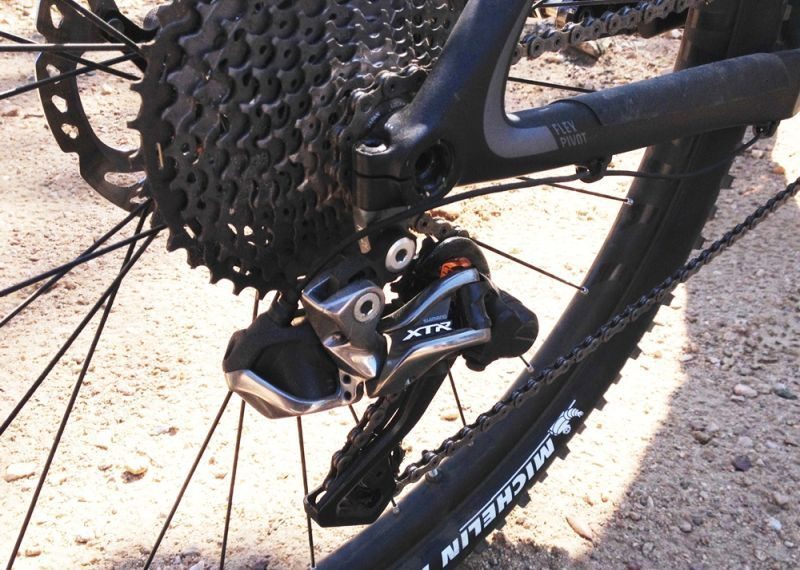
Shimano is the pioneer of direct mount rear derailleurs.
Rear derailleur technology is evolving and Direct Mount technology is becoming more widespread. The question will arise as to what your bike is equipped with, whether it is a road bike or a mountain bike.|>
Direct Mount rear derailleur: Shimano leads the way
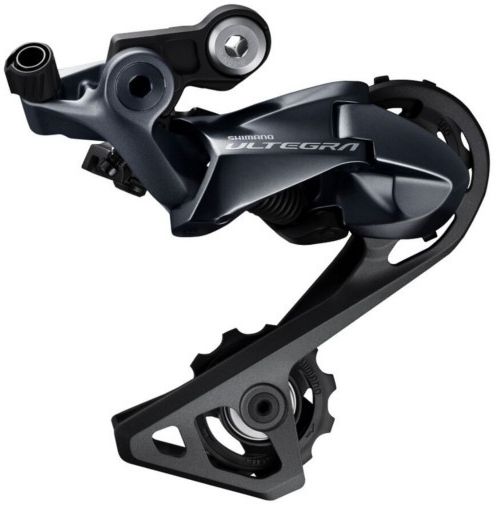
A latest generation MTB derailleur compatible with Direct Mount and classic systems.
This new technology has been developed in response to demand from frame manufacturers. For the moment, only Shimano is able to offer this technical solution. This is something to consider when purchasing a bike if you wish to change the derailleur to another brand at a later date. Your frame will therefore determine whether you have a classic or Direct Mount version. The derailleur hanger comes in two forms. Either the classic form, where the derailleur is attached to the threaded part of the derailleur hanger. Or in a Direct Mount configuration, where the derailleur is attached on either side of the derailleur hanger. New rear derailleurs such as the Shimano SLX, XT and XTR, as well as the Ultegra R8000 and Dura Ace 9100, are originally designed for classic mounting. They are equipped with a removable metal piece to adapt to a Direct Mount frame. During assembly, you must either keep the metal bracket (standard assembly) or remove it and attach the derailleur directly to the frame bracket.|>
How to recognise a standard derailleur hanger and a Direct Mount hanger
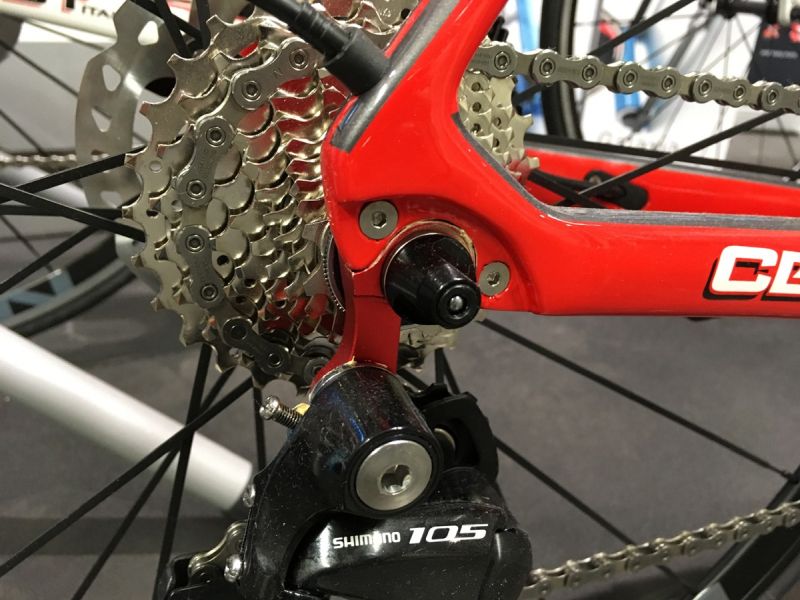
Here is a classic derailleur hanger on a road bike frame. It is fairly easy to recognise a classic or Direct Mount derailleur hanger.
A classic derailleur hanger is often short and the derailleur is fixed in line with the wheel.
A Direct Mount derailleur hanger is offset to the rear of the frame.
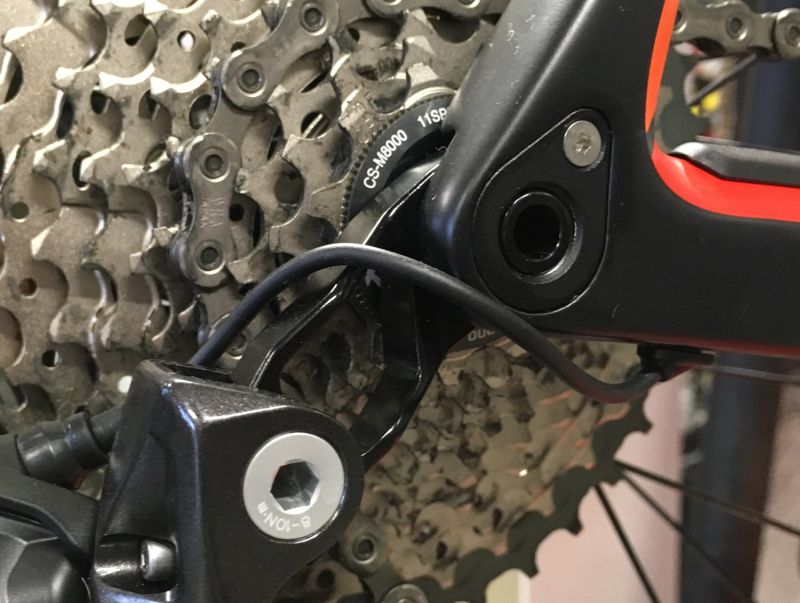
This is what a Direct Mount rear derailleur hanger looks like. This new system obviously has an advantage. When you fall, it is often the derailleur that takes the brunt of the impact. With this system, the mounting bracket (or extension) between the derailleur and the frame acts as a fuse. Instead of bending or breaking the frame, it is this small metal part that will bend. In the case of a Direct Mount, it is the longer bracket that acts as a fuse. The risk of damaging the derailleur is much lower, as is the risk of damaging the frame directly. This is because the derailleur is positioned slightly closer to the rear wheel and is therefore less exposed on the side of the bike.|>
Technology that will set the standard

To convert a rear derailleur for road or mountain bike use to Direct Mount, simply remove the small aluminium bracket.
Unfortunately, this is not an exact science. There is still a possibility of damaging the frame, but this is greatly reduced with this technology. We recommend that you carry a spare bracket with you, or this small metal part in the case of a standard installation. If possible, a spare frame bracket is the best solution for repairs. The more you can do, the better. When mountain biking, it is always advisable to carry a multi-tool for repairs. The derailleur is very often attached using a hex screw (3, 4 or 5 mm). A derailleur hanger is also used, but in a smaller size (2, 2.5 or 3 mm). Given how little space it takes up, it is worth having one.
Loading...
Suggestions

TOP SEARCH CATEGORY
- Cassette
- Helmet
- Saddle
- Bottle
- Chain
- Chainring
- Tyre
- Tape
- Stem
TOP BRAND SEARCH
- Assos
- Garmin
- Gobik
- Castelli
- Pinarello
- Shimano
TOP PRODUCT SEARCH
- Shimano Ultegra CS-R8000 11-speed cassette
- Road tyre Continental Grand Prix 5000
- Shimano 105 R7000 11-speed road bike cassette
Products
No results in products
No results in categories