
Punctures have always been a major problem for cyclists, regardless of the discipline they practise. However, high-quality parts designed to resist punctures can help prevent them.amp;eacute;viter les crevaisons à vélo.
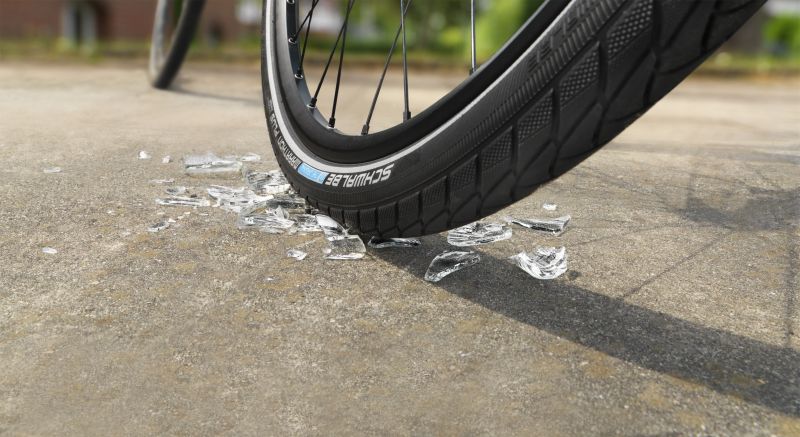
There are many technical solutions available to reduce the risk of punctures.
Puncture-resistant tyres
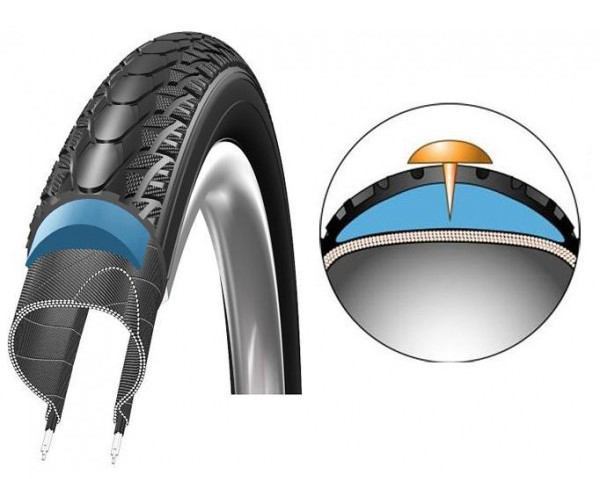
The Schwalbe Marathon range, with integrated puncture protection, is one of the most effective against punctures. Disadvantage: slightly heavier.
It is designed to resist punctures thanks toa reinforcement strip installed by the manufacturer under the tread. In most cases, the tyre reinforcement is made of high-density rubber, although some manufacturers offer Kevlar-reinforced tyres in their premium product ranges. However, it should be noted that the puncture protection is only located under the tread and does not prevent the risk of the inner tube being pinched or perforations on the sidewall of the tyre.The anti-puncture inner tube This type of inner tube is manufactured according to each manufacturer's own design. It can be dimpled, ribbed or grooved to better resist pinching and limit the enlargement of a hole in the event of a puncture. The reliability of puncture-resistant air chambers can be optimised with puncture prevention fluid.lt;br />
Puncture prevention fluid
This product can be used on inner tubes as well as on tubeless or tubeless-ready tyres. It works by sealing holes caused by punctures.This anti-puncture gel allows the user to continue riding without having to re-inflate a punctured tyre. Injected at a rate of 40 to 60 ml into each tyre, it can seal holes up to 6 mm in diameter.
The anti-puncture strip is available in a circular version that varies according to the dimensions of the tyre and as an open strip that can be cut to size. The anti-puncture strip is installed between the inner tube and the tyre, and provides additional protection against punctures from the tread.|>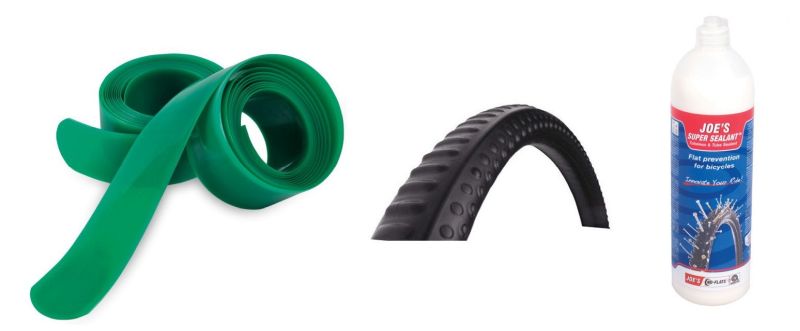
Anti-puncture strip, anti-puncture inner tube and preventive liquid." width="800" height="331" />Tubeless and Tubeless Ready tyresTubeless and Tubeless Ready tyres
These tyres can be fitted without an inner tube, eliminating the risk of punctures due to pinch flats. Despite their weight disadvantage, they offer exemplary flexibility and comfort, both on the road and on mountain bikes. Some Tubeless tyre models also feature a puncture-resistant reinforcement strip.
Solid tyres
These tyres are less common and are more suitable for use on roads or tracks. Although this type of tyre is completely puncture-proof, its poor cycling comfort and road holding have given it a bad reputation. Manufacturers, its poor cycling comfort and road holding have given it a bad reputation. Manufacturers also offer solid inner tubes that can be fitted with conventional tyres. This improves road holding, although the wheel remains much heavier than a conventional wheel.
The tubular tyre
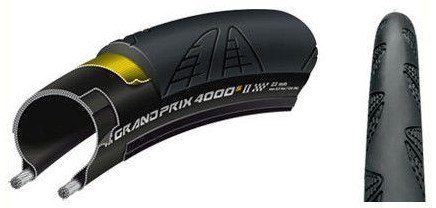
With its anti-puncture strip, the Continental Grand Prix 4000s II tyre
is a benchmark in terms of performance, endurance and resistance.
This tyre is increasingly used in training and leisure cycling, although it is designed more for competition. The tubular tyre is a combination of a tyre and an inner tube attached directly to a rim specially designed for this purpose. This eliminates the risk of punctures, and the anti-puncture reinforcement can be particularly effective. Furthermore, unlike a tyre, it is possible to ride a few kilometres with a punctured tubular tyre!|>Tips for avoiding punctures when cycling</h3> In addition to using puncture protection, the cyclist's care and responsibility improve the longevity of the tyres., cyclists can improve the longevity of their equipment and reduce the risk of punctures by being careful and responsible.br />
Bicycle puncture prevention systems
There are many technical solutions available to reduce the risk of punctures.Puncture-resistant tyres
The Schwalbe Marathon range, with integrated puncture protection, is one of the most effective against punctures. Disadvantage: slightly heavier.
It is designed to resist punctures thanks toa reinforcement strip installed by the manufacturer under the tread. In most cases, the tyre reinforcement is made of high-density rubber, although some manufacturers offer Kevlar-reinforced tyres in their premium product ranges. However, it should be noted that the puncture protection is only located under the tread and does not prevent the risk of the inner tube being pinched or perforations on the sidewall of the tyre.The anti-puncture inner tube This type of inner tube is manufactured according to each manufacturer's own design. It can be dimpled, ribbed or grooved to better resist pinching and limit the enlargement of a hole in the event of a puncture. The reliability of puncture-resistant air chambers can be optimised with puncture prevention fluid.lt;br />
Puncture prevention fluid
This product can be used on inner tubes as well as on tubeless or tubeless-ready tyres. It works by sealing holes caused by punctures.This anti-puncture gel allows the user to continue riding without having to re-inflate a punctured tyre. Injected at a rate of 40 to 60 ml into each tyre, it can seal holes up to 6 mm in diameter.
The anti-puncture strip is available in a circular version that varies according to the dimensions of the tyre and as an open strip that can be cut to size. The anti-puncture strip is installed between the inner tube and the tyre, and provides additional protection against punctures from the tread.|>
Anti-puncture strip, anti-puncture inner tube and preventive liquid." width="800" height="331" />Tubeless and Tubeless Ready tyresTubeless and Tubeless Ready tyres
These tyres can be fitted without an inner tube, eliminating the risk of punctures due to pinch flats. Despite their weight disadvantage, they offer exemplary flexibility and comfort, both on the road and on mountain bikes. Some Tubeless tyre models also feature a puncture-resistant reinforcement strip.
Solid tyres
These tyres are less common and are more suitable for use on roads or tracks. Although this type of tyre is completely puncture-proof, its poor cycling comfort and road holding have given it a bad reputation. Manufacturers, its poor cycling comfort and road holding have given it a bad reputation. Manufacturers also offer solid inner tubes that can be fitted with conventional tyres. This improves road holding, although the wheel remains much heavier than a conventional wheel.
The tubular tyre
With its anti-puncture strip, the Continental Grand Prix 4000s II tyre
is a benchmark in terms of performance, endurance and resistance.
This tyre is increasingly used in training and leisure cycling, although it is designed more for competition. The tubular tyre is a combination of a tyre and an inner tube attached directly to a rim specially designed for this purpose. This eliminates the risk of punctures, and the anti-puncture reinforcement can be particularly effective. Furthermore, unlike a tyre, it is possible to ride a few kilometres with a punctured tubular tyre!|>
Tips for avoiding punctures when cycling</h3> In addition to using puncture protection, the cyclist's care and responsibility improve the longevity of the tyres., cyclists can improve the longevity of their equipment and reduce the risk of punctures by being careful and responsible.br />
The right pressure
This is an important criterion for reducing the risk of the inner tube being pinched. Insufficient pressure increases the impact caused by the rim when crossing obstacles. A tyre with insufficient pressure is also more vulnerable to punctures on the tread surface and on the sidewalls. The ideal tyre pressure is approximately 10% (in bars) of the rider's weight (in kilograms), up to a maximum of 8 bars.
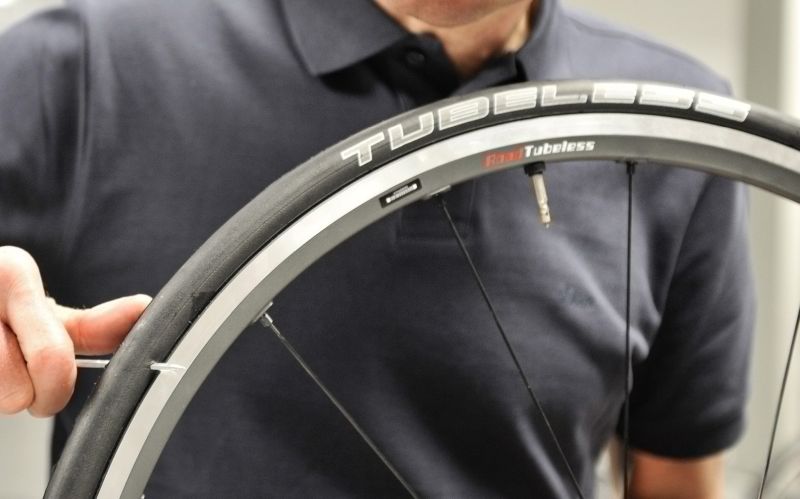
At this point, it's going to be difficult to repair... Tubeless tyres prevent punctures caused by pinching. Regular inspection
This operation allows you to detect any objects embedded in a tyre, especially after a trip, and reduces the risk of punctures.br />
What to do in the event of a puncture?
The puncture repair spray is an all-in-one product that allows you to inflate a punctured tyre without having to remove it. Ita single-use aerosol that injects air and a sealant into the affected tyre. This product can be used on tubeless tyres, inner tubes and even tubular tyres. Choosing a high-quality spray is essential to ensure its effectiveness and the longevity of your tyres.
A spare inner tube is also a reliable alternative for getting back on the road after a puncture.
The essential repair kit for cyclists|>Tyre levers, generally consisting of a pair of plastic tools, one of which can be easily attached to the spokes to facilitate removal.&A scraper is used to prepare the surface of the inner tube or tubeless tyre to ensure optimum grip.lt;br />

Tools and accessories for dealing with bicycle punctures: tyre lever, inner tube, patches, CO2 cartridge, all in a saddle bag. A special glue to apply to the surface around the hole, usually supplied with the patches.
A patch should be placed in the centre of the hole approximately one minute after applying the glue. Pressure must be maintained for at least one minute to ensure perfect adhesion.
A hand pump or CO2 cartridge is required to re-inflate the tyre once it has been refitted.
At this point, it's going to be difficult to repair... Tubeless tyres prevent punctures caused by pinching.
Tools and accessories for dealing with bicycle punctures: tyre lever, inner tube, patches, CO2 cartridge, all in a saddle bag. A special glue to apply to the surface around the hole, usually supplied with the patches.
A patch should be placed in the centre of the hole approximately one minute after applying the glue. Pressure must be maintained for at least one minute to ensure perfect adhesion.
A hand pump or CO2 cartridge is required to re-inflate the tyre once it has been refitted.
Loading...
Suggestions

TOP SEARCH CATEGORY
- Cassette
- Helmet
- Saddle
- Bottle
- Chain
- Chainring
- Tyre
- Tape
- Stem
TOP BRAND SEARCH
- Assos
- Garmin
- Gobik
- Castelli
- Pinarello
- Shimano
TOP PRODUCT SEARCH
- Shimano Ultegra CS-R8000 11-speed cassette
- Road tyre Continental Grand Prix 5000
- Shimano 105 R7000 11-speed road bike cassette
Products
No results in products
No results in categories