How to navigate the standards for attaching front derailleurs on bicycles and mountain bikes: all our advice! Today, the market offers a very wide choice of components, in terms of front derailleurs for road bikes. title="Front derailleur for road bikes">front derailleurs for road bikes and for Mountain bikes. Identifying the right equipment for your bike is crucial to avoid ending up with an incompatible product. How can you understand the current standards for front derailleurs and choose the right equipment for your needs?|>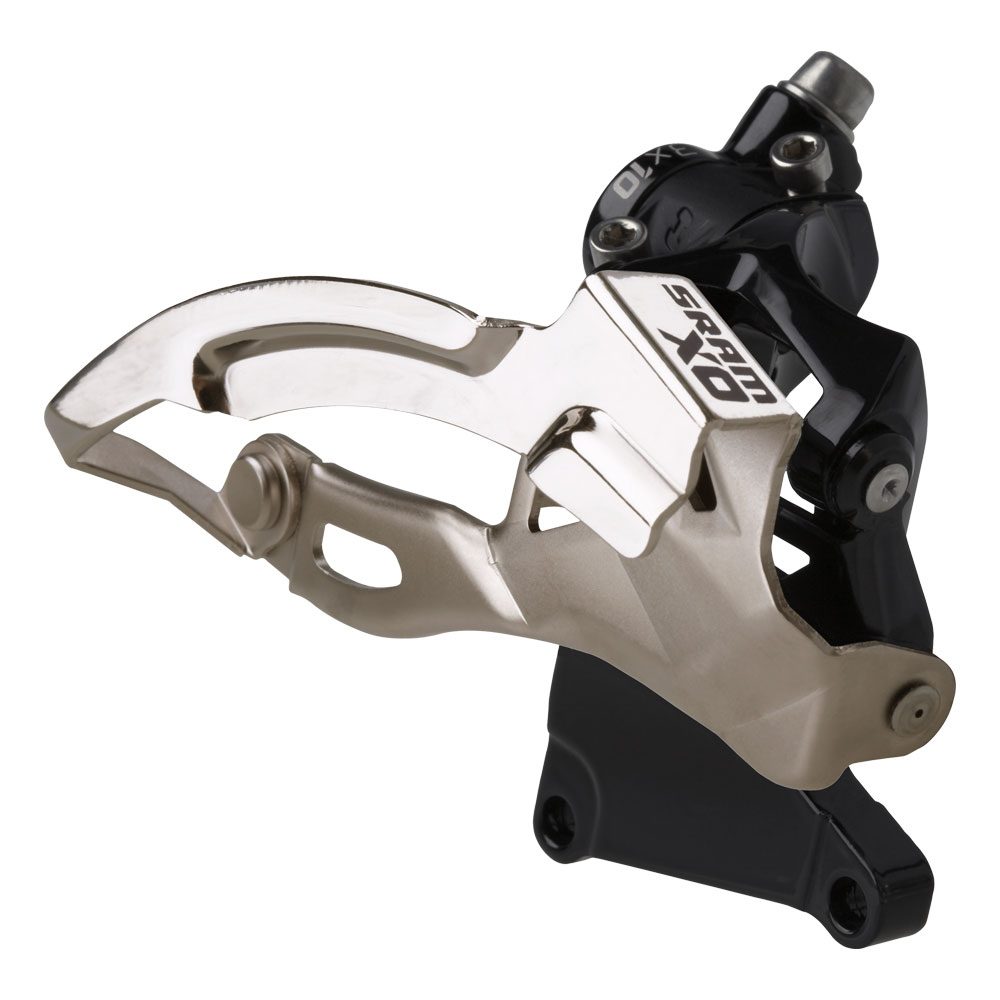
However, the adjustment options for a braze-on front derailleur are more limited, especially in terms of height. It is therefore essential to check the compatibility of the derailleur with the frame, but also with the crankset of the road bike or mountain bike. Group set manufacturers offer specific front derailleurs for classic or compact multi-chainring cranksets. The respective configurations of each derailleur relate to their capacity to manage the number of chainrings in order to obtain a precise chain line.
On a high clamp, it may be easier to adjust the derailleur, as the screws used for this purpose are more accessible. This model also accumulates less mud and dirt when mountain biking. However, the height adjustment of the clamp gives the advantage to the low clamp derailleur, which does not risk hitting the bottle cage mounts. Whenchoosing a front derailleur with a clamp, it is essential to check its compatibility with the frame to ensure correct and functional installation. Derailleur frame clamps are generally available in diameters of 28.6 mm, 31.8 mm and 34.9 mm. Most manufacturers offer several different clamp diametersfor the same derailleur model.|>
Types S1 / S2 / S3: SRAM Direct Mount standards These standards are found on SRAM front derailleurs for mountain bikes. Here, the two fixing screws are located at the base of the derailleur. The centre-to-centre distances of these screws are as follows: - SRAM type S1: 42.7 mm without vertical adjustment. This standard is used on Specialized frames.- SRAM type S2: 22.1 mm without vertical adjustment.
- SRAM type S3: 22.1 mm with 5 mm vertical adjustment. This standard is exactly the same as the Shimano type E2 standard.
E / E2 types: Shimano Direct Mount standards
Shimano's E and E2 Direct Mount standards can be combined on the same front derailleur. This is because an E2 derailleur has two direct screw mounts on the frame, with a centre-to-centre distance of 22.1 mm. This same derailleur can accommodate an additional hanger that attaches to the bottom bracket shell. It is this additional bracket that classifies the derailleur as type E. These two standards can be summarised as follows: Shimano type E2: 22.1 mm mounting centre distance with vertical adjustment.- Shimano type E: type E2 standard + additional bracket for attachment to the bottom bracket shell.
Type D: a high Shimano Direct Mount standard
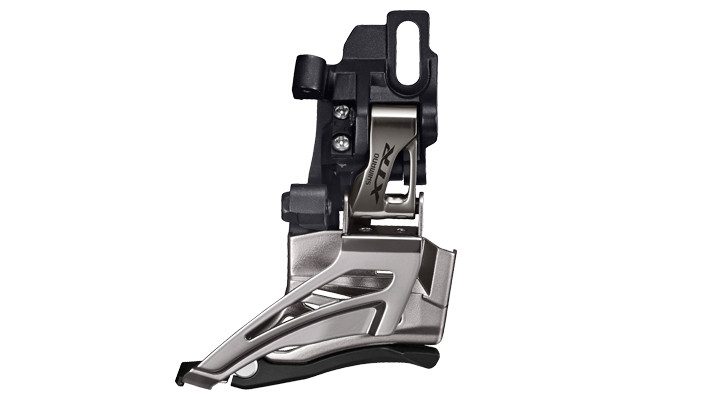
The Shimano Direct Mount derailleurs are also attached directly to the frame using a screw. However, with this standard, the attachment is located at the top of the derailleur, but versions with attachment at the base are also available. Shimano D-type derailleurs offer 5 mm vertical adjustment. They can also be installedwith a clamp on frames that do not have a standard D-type attachment.
Derailleur type according to mounting
Type E, type D, soldered, derailleur standards vary in part depending on their mounting method. Here, it is important to check compatibility with the bicycle frame.Braze-on derailleur
The derailleur on a braze-on bracket, more commonly known as a braze-on derailleur, is attached by means of aThis bracket was originally soldered directly to the frame, which is where it gets its name. Today, this technique is still used on some bicycle frames, but the derailleur hanger is more often screwed on.The brazing lug has become a common mounting solution for front derailleurs, especially on road bikes. This is because the clamp can be difficult to attach to profiled or oversized frames. The brazed dropout also eliminates the risk of damage that can be caused by excessive tightening of the clamps on carbon frames.by excessive tightening of the clamps on carbon frames.However, the adjustment options for a braze-on front derailleur are more limited, especially in terms of height. It is therefore essential to check the compatibility of the derailleur with the frame, but also with the crankset of the road bike or mountain bike. Group set manufacturers offer specific front derailleurs for classic or compact multi-chainring cranksets. The respective configurations of each derailleur relate to their capacity to manage the number of chainrings in order to obtain a precise chain line.
The clamp-on derailleur
This classic mounting type is still very common, especially on mountain bikes. With this standard, the front derailleur for mountain bikes or road bikes is attached to the frame using a clamp ring. The clamp can be located at the top or at the base of the derailleur, allowing the cyclist to choose according to their preferences.be located at the top or bottom of the derailleur, allowing the cyclist to choose according to their preferences and the configuration of their bike frame. Some manufacturers also offer both high and low clamp versions on the same derailleur model.On a high clamp, it may be easier to adjust the derailleur, as the screws used for this purpose are more accessible. This model also accumulates less mud and dirt when mountain biking. However, the height adjustment of the clamp gives the advantage to the low clamp derailleur, which does not risk hitting the bottle cage mounts. Whenchoosing a front derailleur with a clamp, it is essential to check its compatibility with the frame to ensure correct and functional installation. Derailleur frame clamps are generally available in diameters of 28.6 mm, 31.8 mm and 34.9 mm. Most manufacturers offer several different clamp diametersfor the same derailleur model.|>
The Direct Mount derailleur
Direct Mount derailleurs are attached directly to the frame,This design is more reliable, offers greater derailleur precision and preserves the aesthetic appearance of the frame. Several standards have been established for these derailleurs by SRAM and Shimano, and have been adopted by frame manufacturers. These standards correspond to a very precise configuration in terms of the centre-to-centre distance of the mounting screws.Types S1 / S2 / S3: SRAM Direct Mount standards These standards are found on SRAM front derailleurs for mountain bikes. Here, the two fixing screws are located at the base of the derailleur. The centre-to-centre distances of these screws are as follows: - SRAM type S1: 42.7 mm without vertical adjustment. This standard is used on Specialized frames.- SRAM type S2: 22.1 mm without vertical adjustment.
- SRAM type S3: 22.1 mm with 5 mm vertical adjustment. This standard is exactly the same as the Shimano type E2 standard.
E / E2 types: Shimano Direct Mount standards
Shimano's E and E2 Direct Mount standards can be combined on the same front derailleur. This is because an E2 derailleur has two direct screw mounts on the frame, with a centre-to-centre distance of 22.1 mm. This same derailleur can accommodate an additional hanger that attaches to the bottom bracket shell. It is this additional bracket that classifies the derailleur as type E. These two standards can be summarised as follows: Shimano type E2: 22.1 mm mounting centre distance with vertical adjustment.- Shimano type E: type E2 standard + additional bracket for attachment to the bottom bracket shell.
Type D: a high Shimano Direct Mount standard
The Shimano Direct Mount derailleurs are also attached directly to the frame using a screw. However, with this standard, the attachment is located at the top of the derailleur, but versions with attachment at the base are also available. Shimano D-type derailleurs offer 5 mm vertical adjustment. They can also be installedwith a clamp on frames that do not have a standard D-type attachment.