Oval tray
The oval chainring for road bikes continues to spark controversy, but also questions. What are the advantages? Osymetric, Rotor, Ogival: a review of the forces at play.Oval chainrings are not new, with the first experiments dating back to 1905. Closer to home, we find Polchlopek chainrings from 1978, and Shimano's Biopace chainrings, which were marketed from 1983 to 1993. Oval bike chainrings are regularly in the news, particularly in connection with high-profile sporting events. In 2012, Bradley Wiggins and Christopher Froome made a name for themselves in the Tour de France with Osymetric chainrings. This reignited interest in this type of solution.
Oval bike and mountain bike chainrings: the promise

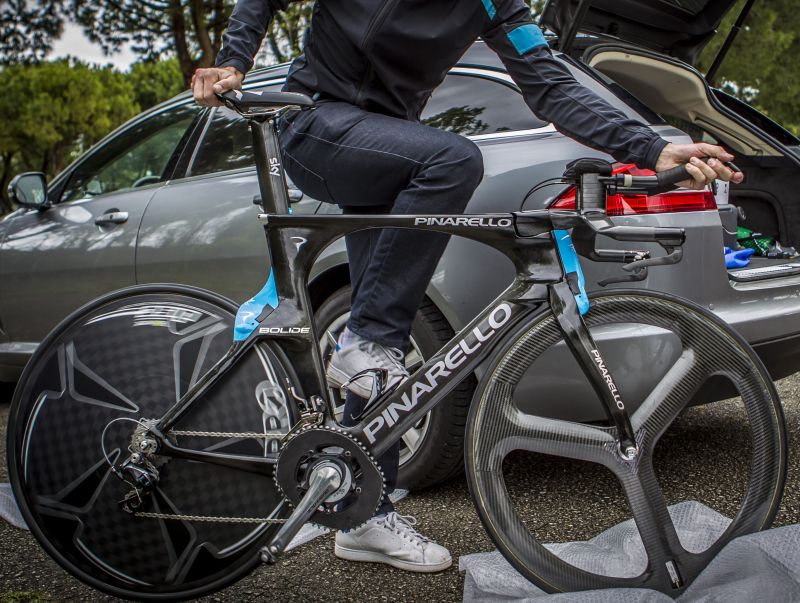
Competition is the best form of advertising for manufacturers of oval chainrings. Here, Team Sky.
On paper and according to manufacturers, oval chainrings offer compelling arguments. French manufacturer Osymetric claims a 10% increase in MAP (maximum aerobic power, i.e. the power achieved at the maximum oxygen consumption threshold). In concrete terms, this translates into a 2% increase in speed. For its part, in its sales pitch, the Spanish company Rotor highlights a reduction in stress on the knee joints, optimised sprints and acceleration, reduced fatigue and improved recovery. It also claims that the production of lactic acid, which causes cramps, is reduced.
Oval chainrings for bikes and mountain bikes: how they work
Oval chainrings eliminate the high and low dead spots found on round chainrings. When the pedal is vertical, pedalling power is cut off because the pedal no longer acts as a lever arm. With an oval chainring, this dead spot is shifted. When the pedal is vertical, the chainring is at its lowest point, making it easier to pass the top dead centre. When the pedal moves downwards, at the moment when the muscles are exerting the most force, the height of the chainring increases, thus making the most of this power. Ultimately, the gear ratio is higher when the muscles are most efficient and lower when energy is reduced.
Oval chainring: Osymetric
Osymetric chainrings are not oval, but feature a "Twincam" design architecture. They are actually two curves symmetrical to a point, which gives them a more "flattened" shape than oval: this is referred to as an oval chainring. This means that the chainring's radius changes in proportion to the force produced by the leg from top dead centre to bottom dead centre.
Oval disc: Rotor
Rotor Qring QXL
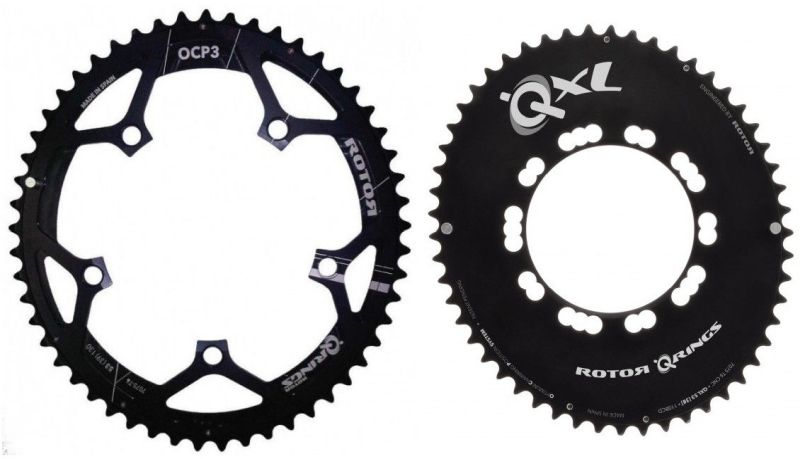
A direct competitor to Osymetric, Rotor offers a different oval chainring design. The range is available in two different versions. Rotor Qrings oval chainrings are 10% oval (with a variation of +5% or -5%), giving them a much less radical profile than Osymetric chainrings. This is an advantage during assembly, as adjusting the front derailleur can be difficult with French chainrings. The latter can also generate significant chain noise.
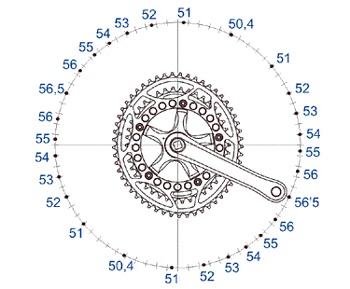
Disadvantages not found with Qrings. Development of the Rotor Qring 53T chainring
Rotor QXL chainrings, on the other hand, have a more pronounced ovalisation of 16%, which, according to Rotor, makes them suitable for a different category of cyclist. Qrings are therefore suitable for riders who deliver average power. With their moderate ovalisation, Qrings reduce fatigue and offer smooth pedalling. They are particularly suitable for prolonged efforts. As for the QXL, which are similar to Osymetric chainrings, they are designed for powerful riders who deliver high intensity during sprints and standing climbs.|>
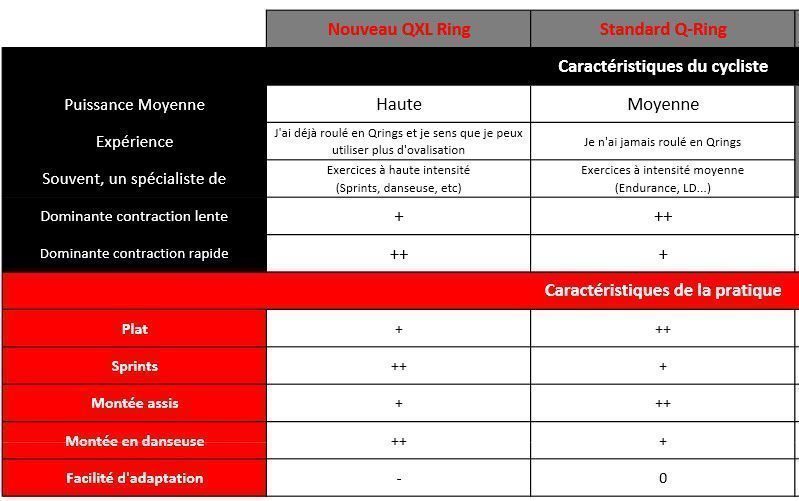
Rotor Qrings QXL differences
A common feature of Rotor Qrings and QXL is their crank angle adjustment mechanism in 5° increments and 5 positions. This feature allows you to set the optimal chainring angle when it offers the maximum gear ratio.This means that these chainrings are easier to adapt to different rider profiles, as well as to different types of cycling, such as road racing or time trials.|>
Oval chainring: Ogival

Ogival oval chainring
Ogival chainrings, another French product, have an extreme, almost pointed profile. The Ogival is particularly suitable for time trial riders. However, it seems to "lose its footing" with fast pedalling frequencies, resulting in jerky operation. In addition, chain noise is very pronounced.
Oval chainrings: effective or not?
The controversy over the effectiveness of oval chainrings continues. Manufacturers such as Rotor have presented studies that are often questioned because of their protocol: bench tests, no "placebo" control ", lack of independence of the authors, etc. Furthermore, other studies tend to play down the advantages of oval chainrings: the study conducted at the University of Franche-Comté under the direction of Frédéric Grappe, that of coach Quentin Leplat, and this one, conducted by a Belgian team.
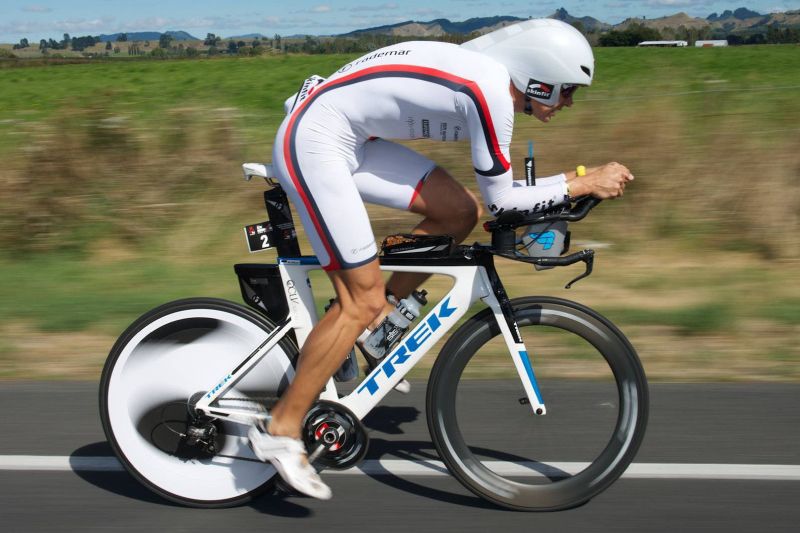
Oval chainrings are particularly used in time trials, especially in
triathlons, where they help reduce fatigue before the running stage.
Among users, there are those who are disappointed, those who are fans, and those who admit to being fiercely distrustful of the sales pitch. The benefits of oval chainrings must lie somewhere between the first two cases. They do make it easier to get over dead spots, and fatigue seems to be reduced.
However, opinions differ on performance gains. Furthermore, personal feel plays a large part. It therefore takes some time to adjust before you feel like you are pedalling naturally when switching from a round chainring to an oval chainring (and vice versa). It should be noted that this adjustment period is quite long with Osymetric and Ogival chainrings.
It is difficult to draw a clear conclusion about the usefulness of oval chainrings. As is often the case with biomechanics, individual physique plays a role, as do the level and type of cycling. We strongly recommend trying them out before purchasing.
Comments
Hello.
I have carried out work and 3D projections based on the Fibonacci spiral design and have created a new type of crank based on this principle, but I have adapted it to my own design and have obtained some results that are worth highlighting through its manufacture.lt;br />Of course, when I mention the possibility of improving the pedal mechanism, I can see the smirks, but that doesn't bother me because I know I'm on the right track.
However, as a pensioner, I have no financial means to prove my achievement.
This would have the advantage of maintaining speed while maintaining power, which would give it a definite advantage over other known models.
The only limit is the person who is satisfied with their condition.
Not me.
Best regards.
Do you have a question about this guide? Please visit our contact form by selecting "Question about a guide" and don't forget to specify the name of the guide and/or its web address. Thank you.