Choosing a touring bike: comfort is key
When you ride your bike occasionally, to stay in shape, enjoy the fresh air or admire the scenery along the way, comfort should be your main consideration when choosing a road bike. There is no point in buying a high-performance bike for leisure use. In addition to being less comfortable, bikes designed for high-level riding require more rigorous maintenance and basic knowledge of bike mechanics. To ensure maximum comfort, cyclists should opt for an aluminium road bike frame with a low centre of gravity for greater stability. The angle of the seat tube will be more pronounced and the horizontal tube of the frame will be shorter to promote an upright position that is less stressful on the back. The frame is therefore more upright than sloping, resulting in an above-average Stack to Reach ratio of 1.50.
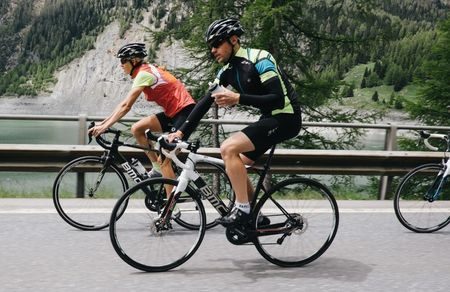
When it comes to bike components, comfort and robustness are key. A generously padded round bike saddle will provide maximum comfort, regardless of the distance the cyclist plans to cover. Aluminium bike wheels absorb vibrations more effectively and are more robust and less prone to skidding when braking with V-brakes.|>
Choosing a sports bike: focus on endurance
In cyclosport, where cyclists generally cover more than 5,000 km per year, performance and reliability are sought after without neglecting the comfort essential for endurance. Generally, the weight of a sports bike is around 10 kg to achieve the best compromise between strength and performance. The aluminium bike frame is very popularin competitive cycling due to its high resistance and reliability. You can also opt for a carbon frame, especially if you regularly ride on mountainous terrain. In both cases, the bike frame should be more compact, with shorter chainstays, a more open seat tube angle and a lower bottom bracket for a better balance between stability, road holding, aerodynamics and rigidity.

When it comes to wheels, aluminium models are just as suitable as carbon wheels, depending on the budget the cyclist wishes to allocate. However, it is essential to fit special soft rubber brake pads for greater reliability on carbon wheels. The wheels can be used with a bike tyre or tubeless tyres. A well-padded saddle with cut-outs is ideal for regular long and medium-distance rides. This saddle model is able to effectively absorb vibrations while minimising compression in the perineal area.|>

As for sports bikes, components such as the front and rear derailleurs, crankset and cassette must meet the performance criteria required for advanced riding. Compact cranksets are also a versatile alternative to consider. To enhance their cycling experience, cyclists can even opt for an electric bike groupset.|>
Choosing a competition bike: maximising performance
In competition, weight and performance take precedence over comfort to ensure the best energy efficiency. With this in mind, these types of bikes are extremely rigid and weigh around 7 kg. The aim is to enable an aerodynamic position and more effective attacks and sprints. Given the importance of lightness in racing, carbon frames dominate the competitive cycling world.|>
In addition to being very light, carbon provides considerable rigidity, an essential criterion for the responsiveness of a bike. The frame geometry is generally compact, with short chainstays, a less sloping seat tube and a shorter wheelbase. The horizontal tube of the frame is longer to promote an aerodynamic position. For the same reason, the wheels of the competition bike are made of carbon, preferably fitted with tubular tyres, partly to reduce weight and partly to improve the conversion of energy applied to the pedals. For mountainous terrain, low-profile wheels are ideal, while medium-profile wheelsimprove air penetration on flat and hilly terrain. Cyclists can even choose to fit a disc wheel or a high-profile wheel at the rear to improve aerodynamics, especially in time trials.amp;nbsp;

Competition saddles are generally flat with little or no padding on some modelsto minimise aerodynamic drag. Although comfort is a minor factor in competition, a cycling shorts with ahigh-quality chamois pad can improve the cushioning of these flat saddles. The components of a competition bike are top of the range to ensure fast and flawless gear changes. While performance is a priority in advanced and high-level cycling such as competition and cyclosport, comfort is more important when riding a bike for leisure. Several essential criteria relating to bike configuration must be observed in this regard. Choosing the right bike for the activity guarantees the best experience for the cyclist on their ride.p>