Choosing a road bike or mountain bike’-velo-de-route.html">road bike, mountain bike, cyclocross bike or triathlon bike is not limited to its aesthetic appearanceamp;eacute;tique, nor to the materials used to make the frame and other components. Geometric measurements are a technical aspect that must be taken into account.
Geometry defines the behaviour of the bicycle, as well as its suitability for the type of use and the physical characteristics of the cyclist.|>
Overview of bicycle geometry measurements
Time trials, climbing, touring, cyclosport, city riding, every type of cycling requires a bike with a specific geometry to meet the rider's needs. This geometry is defined by measurements taken on several parts of the frame, illustrated in the diagram below:defined by measurements taken on several parts of the frame, illustrated in the diagram below:
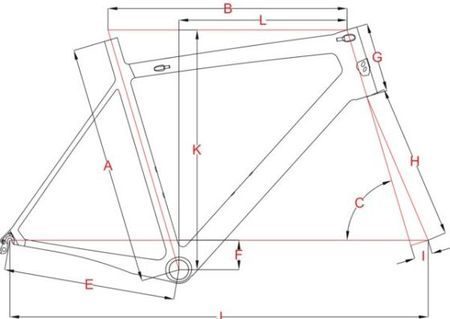
A: The height of the seat tube
Thisthe distance measured between the centre of the bottom bracket and the top of the tube where the seat post clamp is attached. Some manufacturers measure the distance between the bottom bracket axle and the junction between the horizontal tube and the seat tube. This value can therefore be drastically reduced on sloping bicycle frames. This measurement mainly affects the size of the bike, as it is based on a proportion of the rider's leg length.|>
The length of the horizontal tube
This measurement also affects the size of the bike, as well as the reach and the rider's position on the handlebars. A longer horizontal tube will encourage a more curved and aerodynamic position, which is ideal for high-speed riding. A shorter horizontal tube will result in a more comfortable position, but will be less efficient.A shorter horizontal tube, on the other hand, will result in a more comfortable but less efficient position.
On classic frames with a perfectly horizontal tube, the length of the tube is measured betweenaxis of its junction with the seat tube and the axis of the bottom bracket shell. On sloping frames where the "horizontal" tube is inclinedtowards the rear; the axis of the junction with the seat tube must be transferred to a horizontal line from thesteering head tube. The length of the horizontal tube is measured along a perfectly horizontal line, regardless of the type of frame.
C: The head angle or seat tube angle
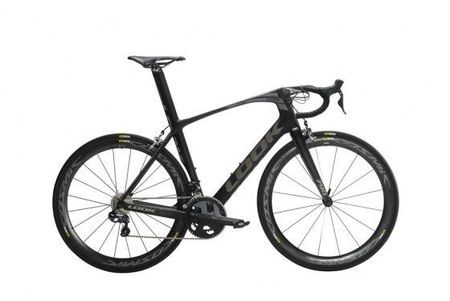
The angle of the seat tube defines theinclination of the seat tube relative to the horizontal plane of the ground. It generally varies from 70 to 77 degrees and determines the distribution of the cyclist's weight on the wheels of the bike, as well as their centre of gravity. The seat tube angle is more acute on bikes designed for comfort, while it is more open on performance-oriented bikes, such as the Focus Izalco Chrono triathlon bike.|>
A less sloping seat tube will reduce the weight carried by the rear wheel, which significantly reduces rolling resistance and improves energy conversion with each pedal stroke.energy conversion with each pedal stroke. However, shifting the weight to the front wheel increases the stress on the steering and impairs the stability and manoeuvrability of the bike.
Conversely, a more inclined seat tube concentrates more weight on the rear wheel. This configuration improves the stability of the bike at the expense of performance.

D: The head tube angle" width="450" height="269" />
The head tube angle is a criterion that determines the behaviour of the bicycle. It is set at around 73° on average, depending on the type. The more acute the head tube angle, the more agile the bike will be. A larger angle means that the head tube is less inclined, which will make the bike more rigid and stable.|>
A smaller head tube angle is therefore ideal for routes with more straight lines than turns. On the other hand, a larger head tube angle will be a significant advantage on a winding route.
It should be noted that the value of the head tube angle can vary, not only depending on the model, but also depending on the size of the bike. For example, on the Focus Cayo Performance bike frame, this angle is 71° in size XS and 73° in size XL.
example of the Focus Cayo Performance bike frame, this angle is 71° in size XS and 73° in size XL.
" width="450" height="271" />
E: The length of the bases
With the fork at the level of the bicycle, the length of the frame bases defines the wheelbase and the behaviour of the bicycle. The bases canbe between 380 and 420 mm depending on the type of bike. This value also directly affects the bike's handling.
Longer bases will be more flexible and comfortable, but will result in a loss of energy when pedalling hard. This configuration is more suitablefor cycle touring and leisure riding.
A bike designed for racing or competition will have shorter bases, a feature that improves the rigidityand improve the bike's responsiveness to each pedal stroke. However, comfort and vibration absorption will be reduced.
F: The drop or lowering of the bottom bracket
This measurement is taken between the axis of the two wheels and the axis of the bottom bracket. This lowering, which varieséénéralement between 55 and 80 mm, defines the ground clearance of the bicycle, but also its centre of gravity. The greater the value, the less ground clearance the bicycle will have.
A higher drop will lower the bike's centre of gravity and improve agility and handling in high-speed corners. However, the bike's pedals are more exposed to impacts on rough terrain or when riding over bumps.
A reduced drop will improve the bike's ability to clear obstacles. However, cornering will be less comfortable and, above all, less reliable due to the height of the centre of gravity.

G: The height of the head tube
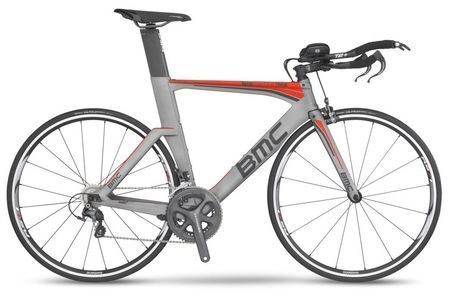
The height of the head tube varies depending on the type of bike, but also on its size. It can range from 77 to 200 mm. On competition bikes, lower head tubes are preferred to ensure optimal rigidity. This is the case with the BMC Timemachine triathlon frame, which has a 97 mm head tube in size S. The reduced height also promotes a more aerodynamic riding position, but will significantly reduce comfort.|>
A higher head tube, on the other hand, will provide more comfort and is more suitable for cycle touring. However, rigidity will be maintained with this configuration.
H: Fork height
This measurement is taken between the base of the fork pivot, where the lower bearing of the headset is located, and the axis of the front wheel. It varies depending on the model of fork installed on the bicycle frame and mainly determines the compatibility of the front wheel.of fork installed on the bicycle frame and mainly determines the compatibility of the front wheel.
I: The fork offset
This value corresponds to the offset between the steering head tube axis and the front wheel axis. Its value, which can vary from 40 to 50 mm, affects the stability and rigidity of the bike, as well as the agility of the steering.
A bicycle designed for cycle touring witha high fork offset will be more manoeuvrable and stable. However, it will be less rigid, especially when the cyclist adopts a dancing position.
A lower offset will improve the rigidity of the bike. This type of configuration is more suitable for high-level practices such as racing and competition.
J: The wheelbase
The wheelbase is measured between the axles of the two wheels of the bicycle. It depends mainly on the size of the bicycle, the length of the chainstays, the fork offset and the angle of the head tube. Its value generally varies between 950 and 1146 mm.
Stack and Reach: separate valuesà
Stack and Reach are values that have long been used on triathlon bikes. Their use has become widespread on all types of bikes since2008, as these measurements allow cyclists to better identify the geometry that suits them best according to their riding style and physique. These two measurements are also more reliable, asthey are not affected by numerous criteria, such as the type and angle of the head tube, the type of frame (classic or sloping), the length of the fork or seat post, or the length of the frame's chainstays./p>
The respective measurements of the Stack and Reach are determined by transferring the axis of the bottom bracket and theaxis of the highest part of the head tube to form a virtual right angle. The Stack is equal to the vertical measurement, while the Reach corresponds to the horizontal measurement on this virtual angle.
K: The Stack
A high stack will result in a more upright position for the cyclist on the saddle and provide greater comfort. It will also allow for fairly powerful pedalling without having to get into a dancing position. However, the bike's centre of gravity will be higher, especially on a frame withThis criterion inevitably reduces the precision and stability of the bike, especially in corners. This criterion inevitably reduces the precision and stability of the bike, especially when cornering. This geometry is therefore more suitable for less rigorous uses such as cycle touring.p>
L: The Reach
A high Reach corresponds to a more slender geometry, promoting a more aerodynamic position on the bike. This configuration is more focused on performance than rider comfort, and is better suited to high-level cycling.
A shorter reach, on the other hand, will allow for a more comfortable position for the cyclist and is more suited to recreational use. Performance will be lower on this type of bike due to air resistance.|>
The Reach to Stack Ratio: a decisive value
It is in the Stack to Reach ratio that the value of these two measures really comes into its own. This ratio, which has an average value of 1.50, is obtained by dividing the Stack value by the Reach value.|>
A ratio greaterA ratio greater than 1.5 refers to a frame designed for comfort and stability, intended for cycle tourists. This is the case for the Trek 520 bicycle frame, with a Stack of 625 mm and a Reach of 392 mm for a ratio of 1.59 in size 60.
A lower ratio identifies bicycle frames designed for racing, competition, training or cyclosport. The more slender frame allows the cyclist to adopt a more aggressive and aerodynamic position. This is the case with the BMC TimeMachine frame, with its 480 mm stack and 393 mm reach for a ratio of 1.22 in size S.|>
While every aspect of the configuration has an important role to play, the geometry is not the main factor that will determine the bike's behaviour., geometry is not the main factor that will determine how a bike performs on the ground. As a general rule, a more compact bike offers better performance, while a larger bike provides greater comfort and stability. The choice of bike should therefore be based on these measurements to ensure the best cycling experience.