The study of a geometry road bike not only allows you to ensure you choose the right size. In fact, thedesign of a road bike frame is a matter of compromise depending on the type of use for which it is intended. This bike must meet the following requirements:a> is a matter of compromise depending on the type of use for which it is intended. This bike must meet very specific requirements in terms of performance, handling and comfort.
Each manufacturer tries to offer ranges suited to each type of use. Once they have defined their personal expectations, cyclists must therefore compare several competing bikes. This is easy to do with the geometry charts available on manufacturers' websites. All that remains is to know how to interpret them.|>
Bicycle geometry: the horizontal tube
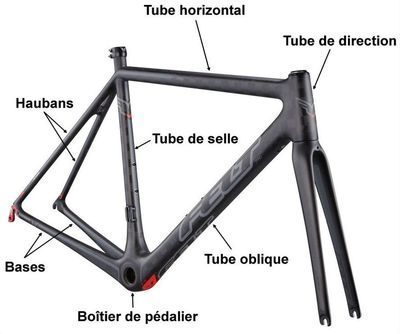
Geometryétrie bicycle frame: the elements defining the "character" of a frame. of a frame.
The horizontal tube is the first element of bicycle geometry to focus on. This is because it determines the size of the bicycle. However, the length of the horizontal tube is not so easy to determine! This is due to theThese have a horizontal tube that slopes towards the rear, meaning that it is fixed lower on the seat tube than on the head tube. This solution is now commonplace on most modern bikes.This solution is now adopted by most road bikes as it provides increased rigidity.now used on most road bikes as it provides additional frame rigidity. This rigidity reduces the loss of pedalling power transmitted to the rear wheel: it is no longer absorbed by the twisting of the frame. In concrete terms, a sloping frame therefore provides increased responsiveness and better acceleration.
Previously, frames were cut "square", meaning that the seat tube and the horizontal tube, which was perfectly horizontal, were the same length. All you needed to know was this value to determine the size of the bike. In the case of a sloping frame, you need to refer to the virtual length of the horizontal tube, i.e. the horizontal length between the axis of the head tube and the projection of the axis of the seat tube. In order to ensure accurate measurements, make sure that they are taken from axis to axis, exactly in the centre of the tube.
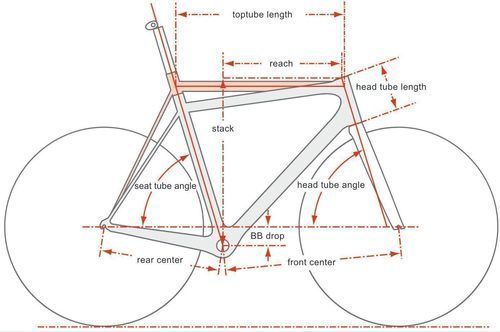
In red, the virtual length (and therefore the length to remember)to be retained) of the Cervélo R3.
The angle of the seat tube is generally set at around 73 degrees and is calculatedaccording to the angle relative to the horizontal axis. The greater the saddle angle, the further forward the cyclist will be positioned, until they are above the pedal axleand promoting pedalling power. This is particularly noticeable on a triathlon bike, where the angle of the seat tube is greater than 75 degrees and is optimised for maximum aerodynamics. It should be noted that the smaller the bike, the greater the angle of the seat tube.|>
Road bike geometry: Reach and Stack
Introduced a few years ago, the concepts of reach and stack provide cyclists with information about their position on the bike. Reach is the horizontal measurement between the bottom bracket axle and the head tube. Stack is the height between the bottom bracket axle and the horizontal projection of the head tube. These two simple measurements provide a quick idea of the rider's position on the bike.and the horizontal projection of the head tube. These two simple measurements quickly give an idea of the position on the handlebars. The higher the Stack value, the higher the position and the more comfortable it will be. The greater the Reach, the more aerodynamic the position will be, as it will be more elongated., the higher the position and the more comfortable it will be. The greater the Reach, the more aerodynamic the position will be, as you will be more stretched out on the bike. This is referred to as the Stack-to-Reach ratio. This can vary, for example, from 1.55 to 1.45 for the most comfortable bikes to the most radical bikes.|>
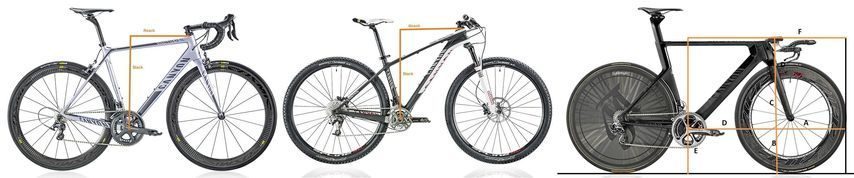
The Reach and Stack on a road bike, mountain bike or triathlon bike.
Bicycle frame geometry: the head tube and fork offset
The height of the head tube plays a central role in the handling of a road bike.road bike. This geometric value determines the rider's position on the handlebars and steering precision. Between a road bike and a sports bike, the height of the head tube can vary greatly, up to 5 cm for frames with the same horizontal tube length. The first effect of the head tube height on the bike's geometry is the rider's angle. Compared to the saddle, on a courier bike, the handlebars will be positioned lower than on a sports bike. This variable is called the "drop". The greater the drop, the more the rider will be inclined: ideal for time trials, but possibly challenging over long distances.|>
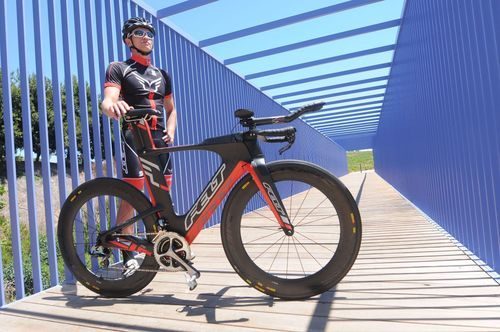
<étrie triathlon bike frame" width="500" />
Felt IA FRD LTD, triathlon bike. Seat angle up to 79 degrees and very low riding position to optimise speed. A bike with radical geometry.
To compensate for excessive rider lean, it is not recommended to add too many spacers between the stem and the head tube. Beyonda 2 cm increase, the rigidity of the steering may be affected, at the expense of steering precision.
Theangle of the head tube is usually between 71 and 74 degrees. This angle is determined by the inclination of the head tube in relation to the horizontal axis. It increases with the size of the bike: smaller bikes therefore have a smaller head tube angle than larger bikes. A closed (small) angle makes the bike more stable, which is comfortable over long distances. An open angle (large) makes the bike more agile, which is desirable in competition. However, when it comes to steering, you also need to consider the trail, i.e. the offset of the fork. This is determined by the distance between the fork legs and thesteering tube and can be between 40 and 50 mm. The greater the fork offset, the more stable the bike will be, but it will lose agilityand handling precision. For greater responsiveness, a smaller offset is therefore preferable.|>
Bicycle geometry: the basics
The behaviour of a bike is largely determined by the length of its chainstays. The longer the chainstays, the more stable the bike will be and the safer it will feel, especially on descents. On the other hand, with shorter chainstays, the bike will be lively and agile, allowing for effective acceleration and particularly good performance in the mountains. The standard chainstay length isapproximately 405 mm, a value that can vary between 395 mm and up to 415 mm. The length of the bases is determined by the distance between the wheel axle and the bottom bracket axle.
Another criterion to consider when determining the ideal chainstay length is comfort. Short chainstays will transmit all information about the terrain to the cyclist. In other words, the shorter the chainstays, the more the bike will transmit every bump in the road to the rider. For a competitive cyclist, this can become very painful. In competition, this criterion is obviously not to be taken into account.
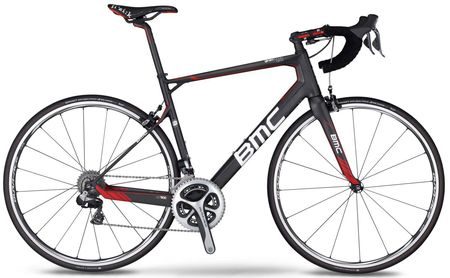
The BMC Granfondo has a geometry with a profile designedComfortable, it nevertheless offers excellent performance thanks to the advanced design of its frame.|>
The BMC Granfondo sports bike has a geometryvertically flexing zones on its seat stays. In addition, although its chainstays are quite long (412 mm), they nevertheless offer flawless lateral rigidity, allowing it to benefit from excellent performance., which gives it excellent performance.
Understanding a bike geometry chart
|>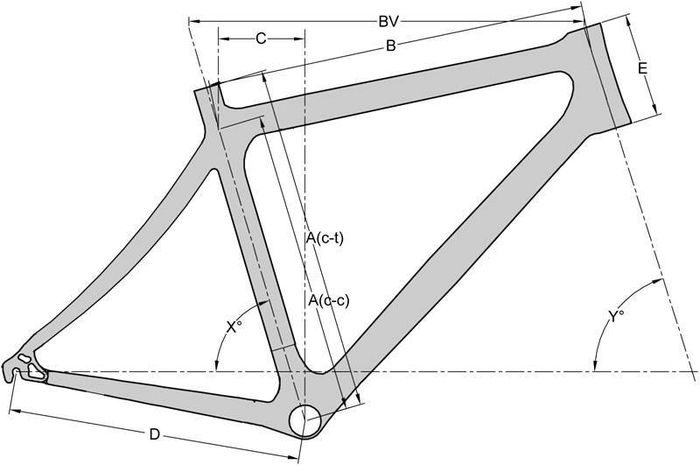
A c-c: centre-centre seat tube (axis-axis), A c-t: centre-top seat tube (axis-seat tube outlet), B: horizontal tube (centre-centre), BV: virtual horizontal tube, C: set back (rearward position of the saddle relative to the bottom bracket), D: length of the chainstays relative to the bottom bracket, E: length of the head tube, X° : seat tube angle, Y° : angle of the head tube.
For the more technically minded (and bilingual), there is a YouTube channel dedicated to the design and geometry of bicycle frames. Highly specialised content:
More info on the system Bike Fitting.
You can also find our posture studies offered in our stores.lt;br />
Comments
Hello, very interesting.
One downside, however, is that I find the directional geometryis a bit of a mess. Offset, caster angle and trail, wheelbase, front weight, tyre profile, ride height, etc.
Motorcycles have made considerable progress in this area since the 1990s.
It is possible to make them stable AND manoeuvrable.
Bicycles are generally too short and lack stability.
Hello
Thank you for your comment. Regarding frame geometry, there are always some differences between manufacturers. Some tend to keep a long horizontal tube, others a shorter one. The angle of the seat tube also varies depending on the brand. It is important to achieve a harmonious distribution of weight. A posture study will help you choose the right bike to avoid having too much weight on the rear, for example. The wheels also play an important role. Wheels that are too rigid require commitment and athleticism when cornering, while more flexible wheels provide comfort and greater flexibility in the bike's handling. The same applies to tyres.Thank you. Best regards.|>
Do you have a question about this guide? Go to our contact form and select "Question about a guide" as the subject. Don't forget to tell us the name of the guide and/or its web address. Thank you.